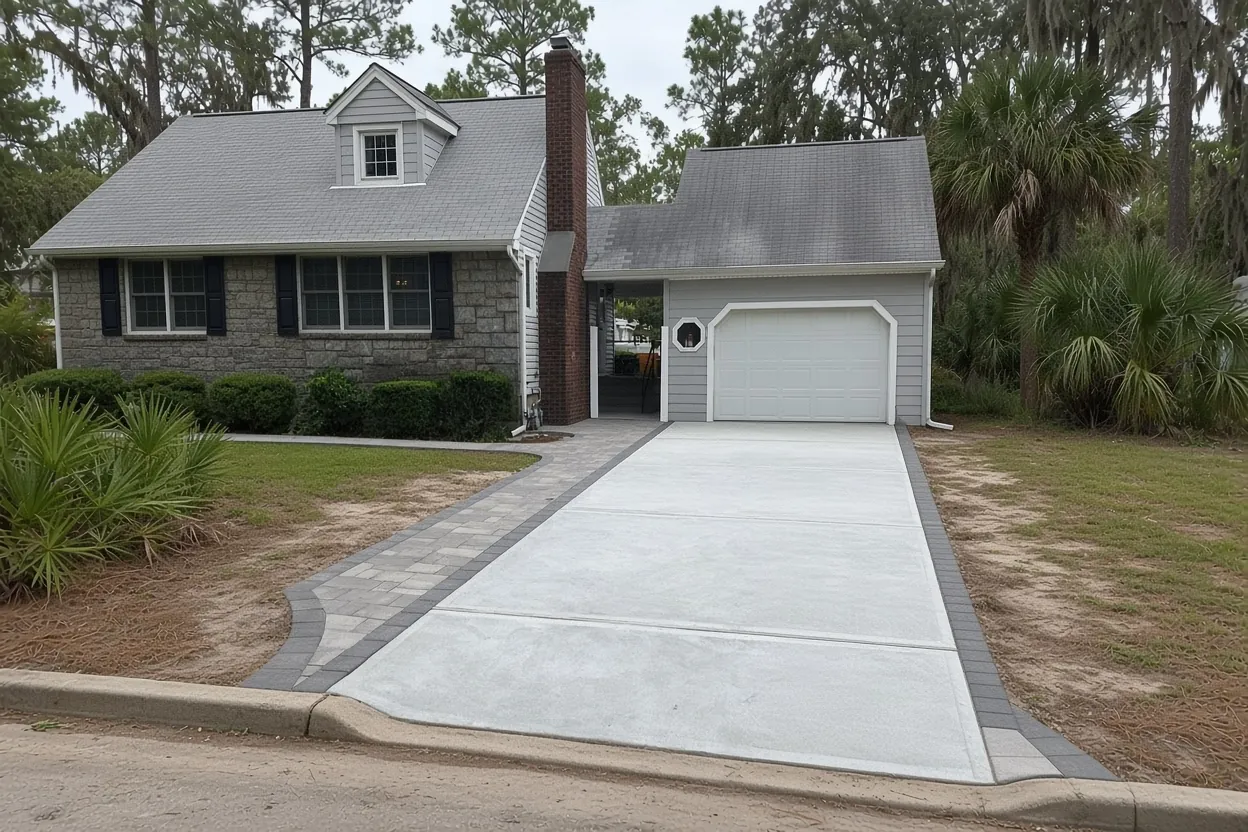
Driveways · Plant City, FL
Concrete Driveways in Plant City
New driveways, widenings and tear-out replacements for Plant City homes, pitched to drain toward the street.
Straight Answers,
Written Quotes
Quick answer
A concrete driveway in Plant City is two slabs on paper: the apron in the city right-of-way, which must be 6 inches of 3000 psi fiber concrete with no steel, and the part on your lot, which we pour 4 to 5 inches with a broom finish. A typical 2-car job runs $5,000 to $10,000 with a free on-site estimate first.
New concrete driveway, driveway extension or tear-out: three price builds
A new pour goes on a lot with a gravel, sand or dirt approach, so the cost is mostly base prep, forms and concrete. A driveway extension adds a second car space or a pad for a boat beside the old slab, and the work that matters is where new meets old: the seam has to be planned and the two slabs separated with a joint. A driveway replacement starts with breaking up and hauling the old driveway, which adds $2 to $4 per sq ft on top of the pour, and then the grade gets reset so water finally drains the way it should.
Our range for the concrete itself is $8 to $14 per sq ft, and a typical two-car concrete driveway of about 500 to 700 sq ft lands at $5,000 to $10,000. The Plant City driveway cost guide walks through the line items. If a front walk or a back patio is on your list too, we can price both on the same visit.
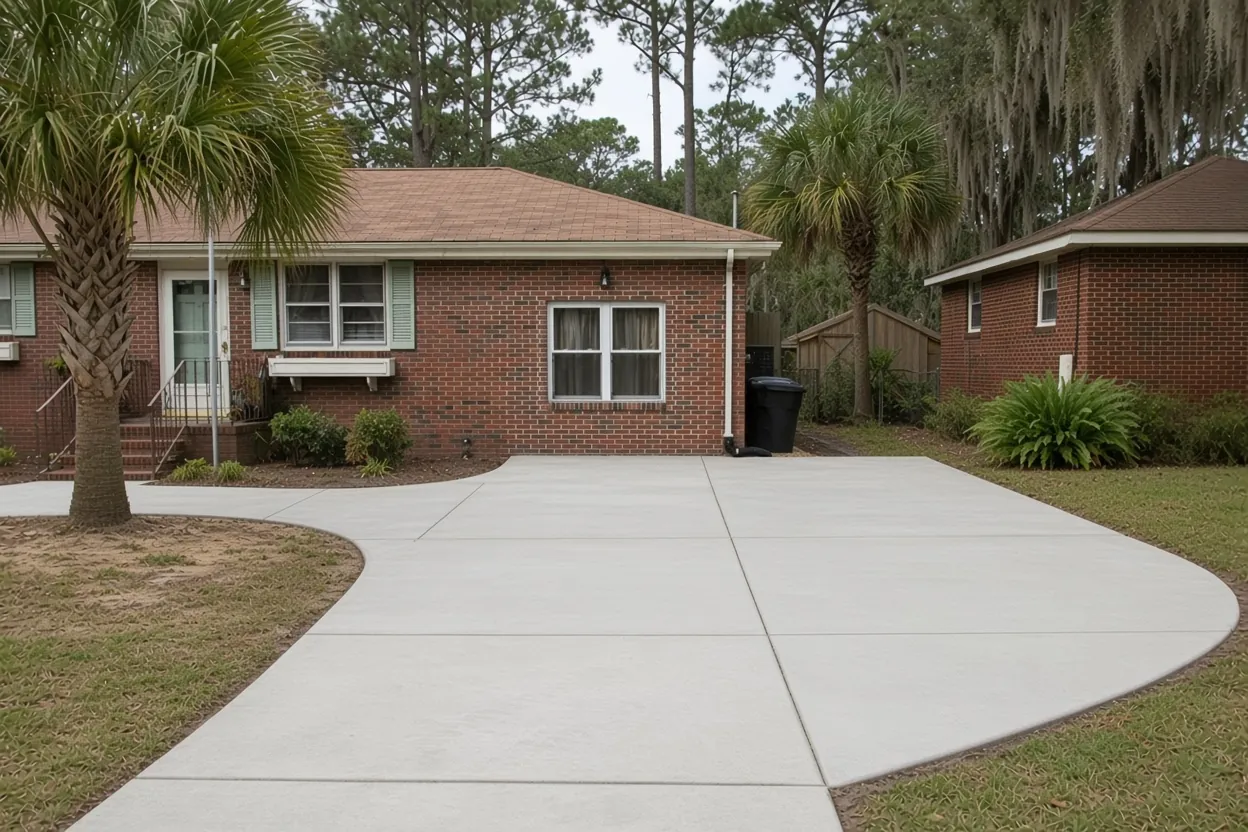
Your side of the property line versus the apron: two specs
On your lot, we quote 4 to 5 inches for family cars. Concrete Network, a trade education site, says going from 4 to 5 inches adds roughly 20 percent to the concrete cost and close to 50 percent to load capacity, and it suggests 5 to 6 inches where RVs, trucks or regular deliveries cross the slab. It pairs wire mesh with 4 to 5 inch slabs and rebar on about a 12 inch grid with slabs 5 inches and thicker. If a loaded pickup or a trailer turns on your driveway, tell us when we meet.
The apron follows the city, not us. Per the City of Plant City help center, everything in the right-of-way is 3000 psi concrete with fiber, at least 6 inches thick, with no rebar and no mesh. Its crack-control joints are full-depth pressure-treated wood at the right-of-way line, along the road and along any sidewalk, not saw cuts. So a quote that runs 4 inches with mesh all the way to the street doesn't meet the city's spec.
Fiber has its own limit. NRMCA says synthetic fibers at normal doses cut early shrinkage cracks and add toughness, but they must not be used to thin a slab, stretch joint spacing or stand in for structural steel. On your side of the line we treat fiber as an extra, never as a swap for thickness.
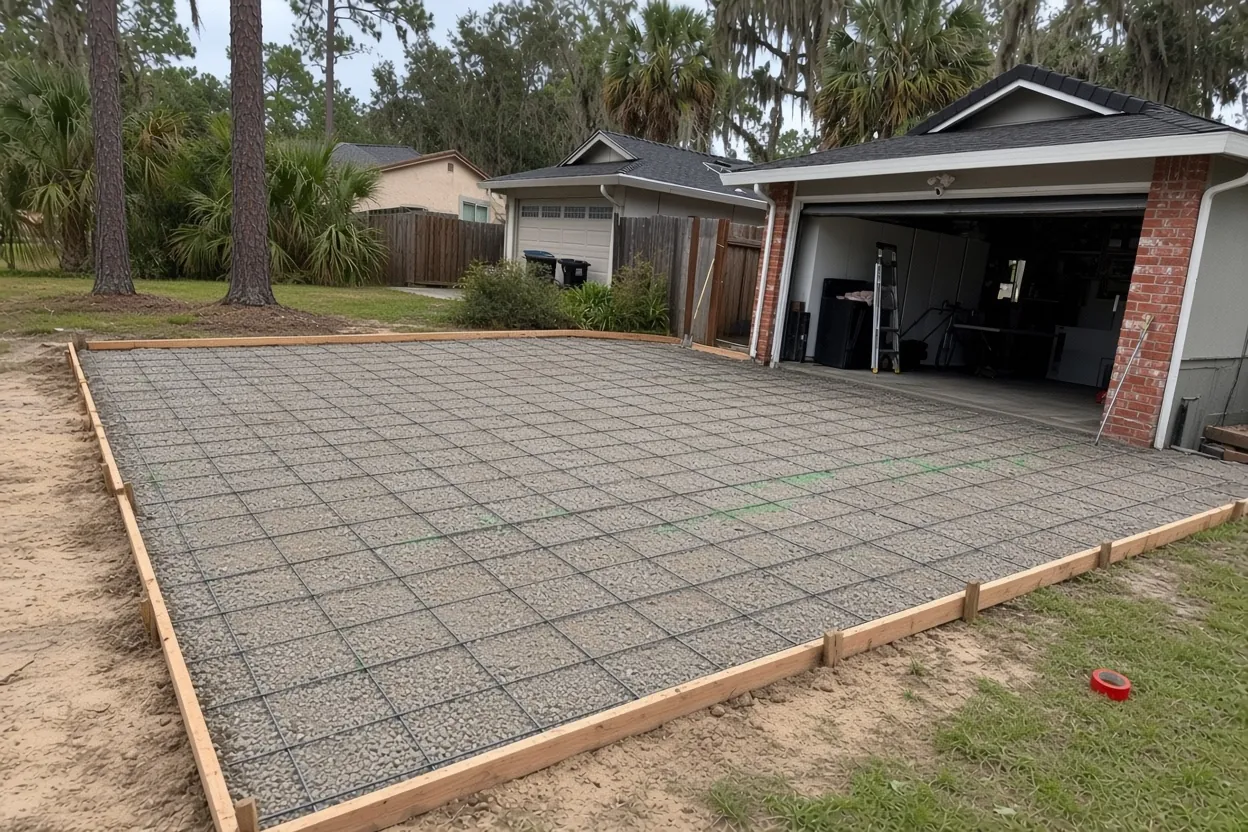
Concrete Pricing
Our ranges for concrete driveway work in Plant City, from a new concrete driveway to a full tear-out. Size, access, the apron and the finish decide where your job lands.
| Job | Per sq ft | Typical project | What moves the price |
|---|---|---|---|
| New 2-car driveway | $8 to $14 | $5,000 to $10,000 | 4 to 5 in. broom finish, about 500 to 700 sq ft; the 6 in. city apron and a culvert are separate lines |
| Driveway extension or extra parking pad | $8 to $14 | Priced by the added area | The joint where new meets old, base prep and access |
| Driveway replacement with tear-out | $8 to $14 plus $2 to $4 for tear-out | $5,000 to $10,000 plus tear-out | Breaking up and hauling the old slab, resetting the grade, rebuilding the apron |
Ranges only. A 20 by 20 foot pad is 400 sq ft, which is about $3,200 at our low rate and $5,600 at our high rate before the apron, culvert or tear-out. Your firm price comes as a free written estimate after we see the site.
Joints, slope and what can't sit under the slab
Control joints tell a slab where to crack. On a 4 inch driveway they go no more than about 10 feet apart and are cut a quarter of the thickness deep, which is 1 inch. Isolation joints go where the driveway meets the garage floor, a walk or old pavement, so each piece can move on its own. On a long, narrow concrete driveway we keep the panels close to square.
The city's rules shape the grade too. The driveway has to slope toward the road, and the city won't approve one that sends runoff toward the house, which it calls an inverted driveway. The same city list says no water service line, meter box, lateral or cleanout goes in or under the driveway, so if one sits where the new slab would go, we work out the layout with you before the quote is final.
Street type changes the plan at the far end. Where the apron meets an asphalt road, the city has the asphalt saw-cut to a straight line so the wood joint sits clean. Where a lot needs a culvert under the driveway, the city requires at least 15 inch concrete pipe with mitered end sections, and it can ask for larger pipe case by case. That pipe is its own line on the quote. Before the pour, the city inspects the apron forms, with 24 hours' notice, and once it's built the apron is yours to maintain. The driveway permit guide covers the paperwork step by step.
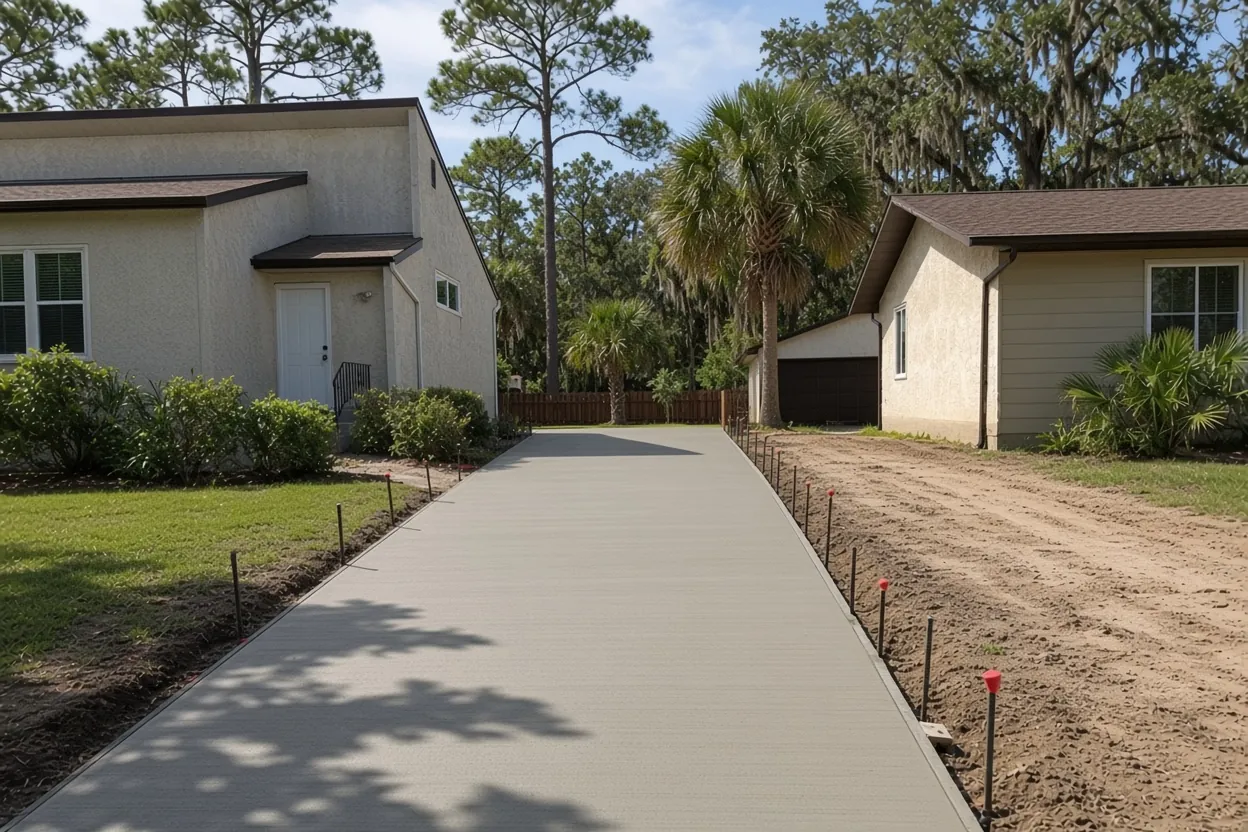
What to Expect, Start to Finish
Measure and look
We walk the lot, measure, and check the street edge, the trees, the utilities and the truck path.
Written quote
Within 48 hours, with the apron, culvert and tear-out on their own lines.
Approvals
Permit, any Certificate of Appropriateness or HOA sign-off, then the pre-pour form inspection date.
Tear-out and base
The old slab comes out if needed, the sand is compacted and the grade is set to drain toward the street.
Pour and finish
Concrete placed, broom-finished, joints set, curing started right away.
Hand-off
You get the date for first use, and the jobsite is left clean.
Driveways on historic blocks and in Walden Lake neighborhoods
On the older blocks around downtown, design review comes before the building permit. The city's historic district standards list driveways among the changes that need a Certificate of Appropriateness in the Northeast Residential, Downtown Historic Residential and downtown commercial districts. They also say existing driveway paving should be kept where it can be, existing granite curbing stays, and poured concrete is an appropriate material alongside brick and concrete pavers. That means a straight replacement in poured concrete is a realistic ask, while widening into the front lawn deserves a call to Planning and Zoning first. The city's historic district resources page explains how to apply.
In Walden Lake, the second approval comes from your neighborhood's HOA board. Neighborhoods such as Forest Park, Forest Club and Sutton Woods hold their own board meetings, and driveway and exterior rules can differ between them. Pull your covenants before you settle on a size, and bring the board's reply to the estimate. The city permit still applies, because Walden Lake is inside city limits.
When a live oak has already lifted the old slab
UF/IFAS says live oaks planted too close to curbs, sidewalks or driveways can grow roots big enough to lift and crack them, and a mature oak can spread 60 to 120 feet wide. On a driveway replacement, a heaved panel beside a big oak is a sign the same thing will happen again if we pour the same slab in the same spot.
So we walk the root zone with you before we quote. Sometimes the fix is shifting the slab edge a foot or two. Sometimes it's putting an isolation joint where the lift starts, so one panel can move without cracking its neighbors. Sometimes it's leaving the tree more room. If you're thinking of taking a tree out instead, ask Planning and Zoning first, because the city says tree removal may need approval. Same with raising the grade: the city says adding fill or redirecting water can need approval, to avoid flooding neighbors. The decision on the tree is yours. We'll tell you what we see in the old slab.
Picking a pour date between June storms and October
The National Weather Service dates the West Central Florida rainy season May 25 to October 10. Late May and June bring the strongest storms, July to early September brings the heaviest rain, and mid September into October depends on the tropics. Hurricane season runs June 1 to November 30. Pours happen all year, but summer dates stay loose, and if a storm is on the radar the morning of the pour, we move it.
Heat is the other half. NRMCA's hot-weather guidance says to avoid the hottest part of the day when possible, never add water on site beyond the mix design, never sprinkle water on the surface to ease finishing, and start curing as soon as finishing ends. Plastic shrinkage cracks show up when wind, heat and low humidity pull water off the surface faster than it bleeds up, and windbreaks, shade and fast curing are the fixes it lists. Curing runs 3 to 7 days, and concrete that dries out early can lose up to half its potential strength. Keep cars off for at least 7 days, as IRMCA advises, and longer before a heavy truck rolls on it.
Long county driveways, mined ground and truck access
Past the city line, in Knights or around Bealsville, a house set well back from the road means a long run, priced by the square foot like any other, and it can come with a ditch crossing and a culvert at the road. On county land the right-of-way connection generally goes through Hillsborough County, not the city (check the parcel's Tax District), and our permit guide explains that route.
Ground history matters in a couple of places. Coronet began as a phosphate company town, and the county's historic survey describes Hopewell as dominated by orange groves and abandoned phosphate mines. FDOT's geotechnical memo for the State Road 60 corridor lists mining-related soils as an exception to the area's otherwise workable sand, so on a Hopewell driveway or a Coronet lot we ask what was on the land before. Elsewhere, FDOT's memo describes sand in the top few feet along most of the corridor and a water table at or near the surface across much of the county, so we compact in lifts and grade water away, as the sandy soil guide explains.
Tell us about gates, low branches, septic tanks and soft spots along the route. A loaded concrete truck is heavy, and planning its path keeps your lawn intact.
Photos and answers that speed up a driveway quote
- Your parcel's Tax District from the Hillsborough County Property Appraiser site: PC is city, U is county.
- What the slab carries: cars only, or a boat, camper or delivery truck.
- Photos of the old driveway, the apron and the street edge, showing whether there's a curb or a ditch.
- Where the water meter, cleanout and any buried lines sit.
- Big trees within reach of the planned edge.
- Any HOA or historic district approval you already have.
- Your finish. Broom is our baseline, and stamped driveways are priced separately.
Call (813) 722-1744 or use the contact page. For a garage floor or shop pad poured with the driveway, see concrete slabs.
Frequently Asked Questions
How thick should a concrete driveway be in Florida?
Rebar, wire mesh or fiber for a driveway?
Why can't the apron have wire mesh in it?
How is a tear-out priced compared with a new pour?
My street has a ditch, not a curb. Do I need a culvert?
Can a driveway extension blend in with the old slab?
How many days before I park on the new driveway?
Will my Walden Lake board need to see the driveway plan?
Sources
- Plant City FAQ: driveway requirements, permits, city vs county, City of Plant City
- Plant City Historic District Design Standards, City of Plant City
- Historic District Resources, City of Plant City Planning and Zoning
- Concrete Driveway Installation: 8 Essentials, Concrete Network
- CIP 24 - Synthetic Fibers for Concrete, National Ready Mixed Concrete Association
- CIP 12 - Hot Weather Concreting, National Ready Mixed Concrete Association
- CIP 11 - Curing In-Place Concrete, National Ready Mixed Concrete Association
- CIP 5 - Plastic Shrinkage Cracking, National Ready Mixed Concrete Association
- Florida Thunderstorm Season / Rainy Season, NOAA National Weather Service
- Hurricane climatology, NOAA National Hurricane Center
- Driveways (homeowner technical resource), Illinois Ready Mixed Concrete Association
- Live Oaks, UF/IFAS Gardening Solutions
- SR 60 PD&E Study Geotechnical Memorandum, Florida Department of Transportation District Seven
- Walden Lake Community Association, Walden Lake Community Association
Request Your Free Estimate
Tell us a little about the job. We'll call to set a time to come measure.
Thank you, we have it.
We'll call shortly to set a time to measure. Prefer to talk now? Call (813) 722-1744.
Other Concrete Services
Concrete Patios
Backyard patios, lanai extensions, and screen-room slabs sized for real outdoor living in the Florida heat.
Learn MoreConcrete Sidewalks & Walkways
Front walks, side-yard paths, and city-spec sidewalks with proper joints so they don't crack and heave.
Learn MoreStamped & Decorative Concrete
Stamped and colored concrete for patios, driveways, and entries. The look of stone or pavers in one solid pour.
Learn MoreConcrete Slabs & Foundations
Slabs for sheds, workshops, garages, barns, and additions. Formed square, compacted right, ready to build on.
Learn MoreOur Service Areas
Concrete work across Plant City and its neighborhoods.
Page updated