Stamped Concrete · Plant City, FL
Stamped & Decorative Concrete in Plant City
Stamped and colored patios, entries, walks and driveway borders for Plant City homes, sealed for full Florida sun.
Straight Answers,
Written Quotes
Quick answer
Stamped concrete in Plant City's three historic districts needs a Certificate of Appropriateness before the building permit, and the city's standards ask that new walkways fit the district in materials and color. Everywhere in town the slab is one pour, colored and pressed while it's workable, then sealed. Our range is $14 to $24 per square foot, with a free written estimate after we see the site.
How one pour ends up looking like slate, flagstone or brick
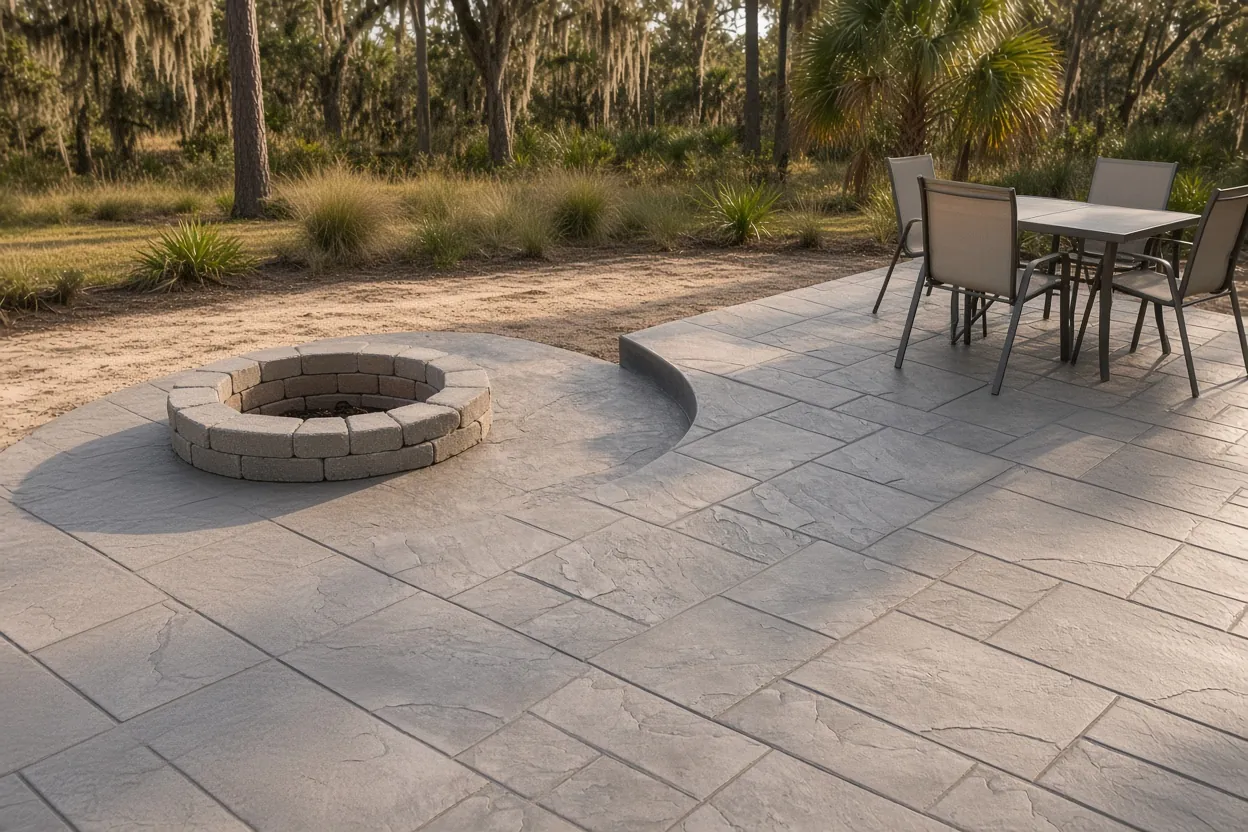
A stamped slab is ordinary concrete with three extra steps. Color goes into the batch or onto the fresh surface, a release agent goes on so the stamps don't stick, and the crew presses the pattern while the concrete is still soft enough to take it. When it cures you have one continuous slab that reads as stone or brick and wears like concrete.
Plant City Concrete Co pours stamped concrete for patios, front entries, walks and driveway borders across Plant City, from the early-1900s homes north of downtown to the newer streets around Walden Lake. The pattern book is the fun part. How the job ages depends on the base under it, the joint layout, the weather on pour day and the sealer schedule you keep afterward.
Still deciding whether you want decoration at all? Price a plain backyard patio slab or a broom-finish driveway first, then compare what the stamp adds.
Pattern, base color and release tone: the three picks you make
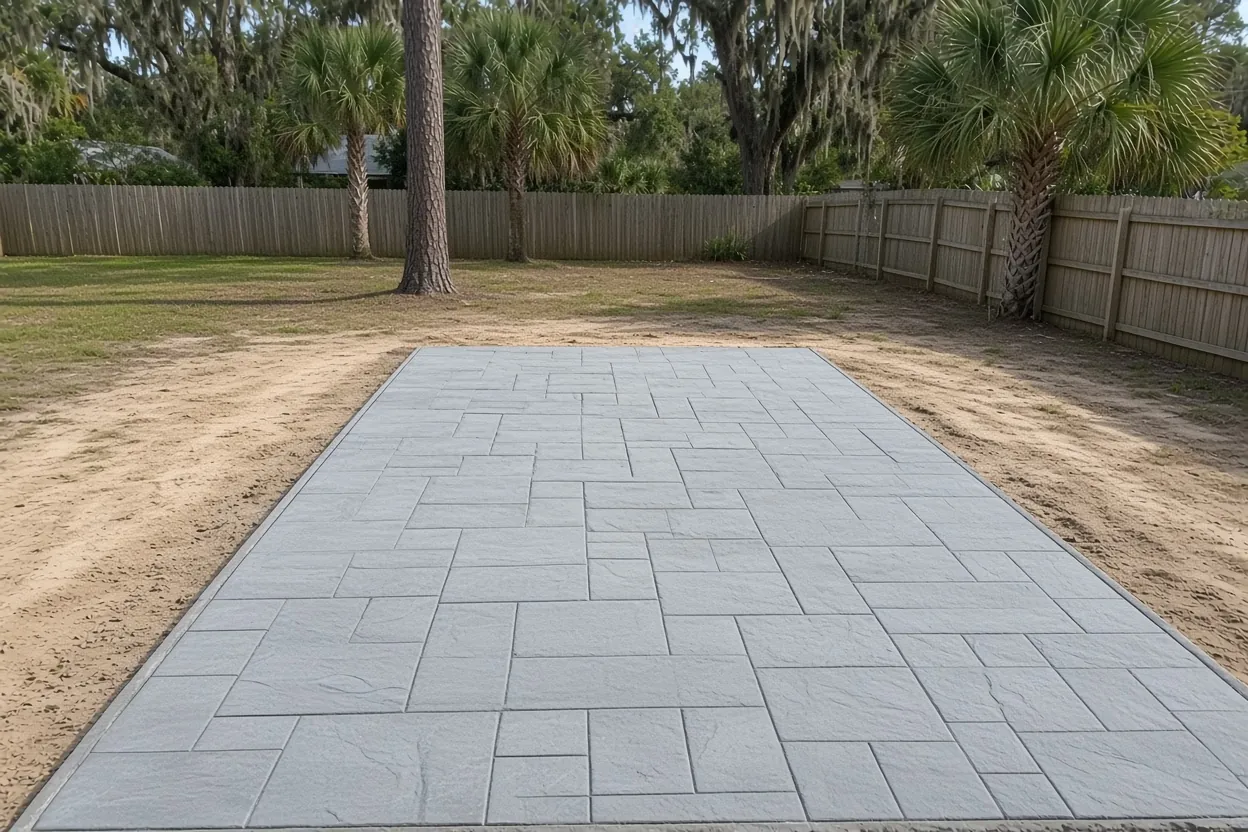
Every stamped job comes down to a pattern, a base color and an accent. Concrete Network describes color as coming from integral color mixed through the batch or from a dry-shake hardener worked into the surface, then layered with a release agent or stain for variation.
- Pattern. Stone, brick and plank looks all work. Match it to the house. A loose flagstone look can feel borrowed on a tidy brick ranch.
- Base color. Pull it from the roof, the trim or an existing walk. Integral color runs all the way through, so a chipped edge shows the same tone underneath.
- Release or accent tone. The darker color that settles into the joints is what makes a pour read as laid stone instead of printed concrete.
- Border and field. A plain or single-color band around a patterned center frames the space and keeps the pattern from running awkwardly into a wall.
Look at samples outside, at the time of day you'll use the space. A warm gray that looks soft under a showroom light can go flat and pale on a west-facing patio at four in the afternoon. Bring a photo of the house and roof to the site visit so we can hold chips against the real thing.
Concrete Pricing
Our stamped range covers pattern, integral or release color and sealer. Tear-out, base fixes and approvals sit on top.
| Job | Per sq ft | Typical project | What moves the price |
|---|---|---|---|
| Stamped patio, walk or entry | $14 to $24 | $5,000 to $16,000 | Pattern, number of color layers, borders, steps and curves |
| Stamped driveway or pool deck | $14 to $24 | $5,000 to $16,000 | Size, traction additive, sealer type, how much area is stamped versus plain |
| Plain broom center inside a stamped border | $8 to $14 for the plain area | Quoted with the border | Ratio of plain to stamped area |
| Tear-out of an old slab | Adds $2 to $4 | Quoted by area | Thickness of the old slab, access for haul-off |
Ranges only. Every stamped job gets a free written estimate after we see the site, with the pattern, colors and sealer named.
Grip on a textured surface after an afternoon storm
Ask about traction first. The National Weather Service's Tampa Bay office puts the local rainy season at May 25 to October 10, with frequent showers and thunderstorms. Concrete Network reports that stamped concrete is often more slip resistant than smooth concrete because of its texture, but it can turn slick when wet, especially under a film-forming sealer, and non-skid additives can go into the sealer for high-traffic areas.
Match the traction plan to how the space gets used:
- Front steps and the walk to the door. Ask for a non-skid additive. This is where people carry groceries in the rain.
- A covered back patio that stays dry. A standard sealer is a fair choice, and you can pick for looks.
- Anywhere near a pool or a hose bib. Treat it as a wet area from day one and choose a deeper texture plus additive.
- A driveway border. Tires care less than feet, but the border is where people step out of the car.
Tell us who uses the space. Kids running from a pool, a parent with a walker and a table that only sees Sunday dinner are three different traction plans, and it is cheaper to settle that before the pour than to strip a glossy sealer after the first fall.
What to Expect, Start to Finish
Site visit
We walk the yard, check where water goes, measure and hold color chips against the house. The estimate is free.
Written quote
Pattern, base and release colors, sealer type and traction additive are listed line by line.
Approvals
If you're in a historic district or a Walden Lake neighborhood, the Certificate of Appropriateness or any HOA approval comes before a pour date is set.
Pour and stamp
Base, forms, concrete, color and pattern in one working window, picked around the forecast.
Cure and seal
Curing starts right after finishing. Sealer follows full cure, and you get the reseal date in writing.
Sealer, sun fade and the reseal calendar
Sealer is the part of a stamped slab you'll deal with again. It blocks water, stains, dirt and chemicals, and Concrete Network puts cleaning and resealing at every 2 to 3 years depending on traffic, weather and chemical exposure. Sun is the other reason. A Florida contractor, CHC Concrete, reports that an unsealed stamped driveway shows visible color loss within one to two seasons in strong Florida sun, so we seal every stamped job we pour.
- The slab cures fully before any sealer goes on.
- First coat goes on, with the traction additive mixed in where you asked for it.
- Wash and reseal every 2 to 3 years. A full-sun driveway border will want the short end; a shaded, covered patio can stretch.
- Reseal sooner if water stops beading or the release color starts to look chalky.
Pick the finish with grip in mind, not just shine. A high-gloss coat makes color pop in photos and makes a pool deck slick. Your written estimate should name the sealer type and say when the first reseal is due, so the upkeep is on paper before you sign.
Stamped slab or pavers on a Plant City lot
Both can be the right call. Plant City's historic district standards list brick, concrete pavers and poured concrete as appropriate driveway materials, and the city's driveway rules say pavers in the right-of-way may be approved by Engineering. So neither one is ruled out on paper, even downtown.
The differences are practical:
- Stamped concrete is one continuous surface with no gaps between pieces to refill, color that runs through the slab and one trade on site. It cracks as a unit if the base moves, which is why joint layout and compaction carry so much weight.
- Pavers move as separate pieces. A settled spot can be lifted and relaid, which helps if you expect to dig later for a pipe or a root, but the sand bed under them has to stay put on the same ground.
On Plant City sand either one lives or dies by the base. If you're collecting both kinds of bids, ask each contractor to write down the base depth, compaction method and edge restraint. We'll price the stamped version with those lines spelled out so the comparison is apples to apples instead of a single number against another single number.
When reviewers care about color: historic blocks and Walden Lake boards
Plant City has three National Register historic districts: Northeast Residential, Downtown Historic Residential and Downtown Commercial. Under the city's Historic District Design Standards, decks and driveways are on the list of exterior changes that need a Certificate of Appropriateness, and the certificate comes before the building permit. Our driveway permit walkthrough covers the filing steps.
What matters for a stamped job is what the reviewers are told to look for. The standards say new walkways should be compatible in size, scale, materials and color, call patterned sidewalks, brick streets and granite curbing important features of the districts, and say existing granite curbing stays. On a Northeast Residential block with brick streets out front, that means the reviewers are weighing how your pattern and color sit next to that brick. Bring the sample, the pattern name and a photo of the house when you apply.
Walden Lake has its own layer. The community lists 30 neighborhoods, such as Forest Park, Forest Club and Sutton Woods, and individual neighborhoods run their own HOA boards. Rules can differ from one neighborhood to the next, so check your own covenants and get any approval they require in writing before we order material, along with the city permit.
Hiding control joints in the pattern on sandy ground
A stamped slab shows every mistake underneath. A soft spot turns into a crack that runs straight across the stone pattern, and a slab that pitches toward the house stains the finish where water sits. Plant City sits on deep terrace sand, and an FDOT study of the SR 60 corridor found seasonal high groundwater within about 1 to 1.5 feet of the surface in places, so we strip, compact in lifts and grade every pad; our guide to pouring concrete on sandy soil walks through the layers.
Joints are the stamped-specific part. Concrete Network's rule for a 4 inch slab is control joints no more than 10 feet apart, cut to one-fourth of the thickness. On a stamped job we lay those lines out before the pour and run them along grout lines in the pattern wherever the spacing allows, so the cut reads as one more joint between stones instead of a scar across the middle of one.
- Slope every stamped surface away from the house. On a driveway the city wants the slope toward the road and doesn't allow inverted driveways that send runoff toward the home.
- Put isolation joints where the slab meets the house, a garage floor or an older walk.
- Keep big decorative fields back from live oaks. UF/IFAS notes their roots can grow large enough to lift and crack nearby drives and walks, and a lifted stamped panel is hard to hide.
Stamping against the clock in July heat
Stamping is a timing job. Color, release and stamps all have to go on while the surface is workable, and on a hot, breezy afternoon that window shrinks fast. The crew can't stop halfway through a pattern to wait out a storm cell either, so the pour date gets picked with the forecast in front of us.
NRMCA's hot-weather guidance sets the ground rules. Avoid the hottest part of the day when possible, don't add water on site beyond the design amount and don't sprinkle water on the surface to help finishing. Its plastic shrinkage sheet says wind over 5 mph, low humidity and high air or concrete temperature all speed surface drying and invite shallow, roughly parallel cracks about 1 to 3 feet apart, and that pouring in the late afternoon or early evening can help when conditions are bad.
- Forms, base and any drain lines get checked before the truck is called.
- Color goes in or on, release goes down and the pattern is pressed before the surface sets.
- Curing starts as soon as finishing ends. Sealer waits for full cure.
If the sky turns while the truck is on the way, we'd rather move the date than stamp in a downpour and grind out a ruined surface later.
Entries, walks, driveway borders and pool decks
Stamped finishes earn their price in a few places around a Plant City home, and each has its own catch.
- Front entries and stoops. Small, seen first and walked on most. Spend the budget on traction and color, not a busy pattern.
- Walkways. A stamped path can tie the front door to the driveway. Where it crosses a public sidewalk or the apron, city rules take over; our walkway and sidewalk work page covers the plain version.
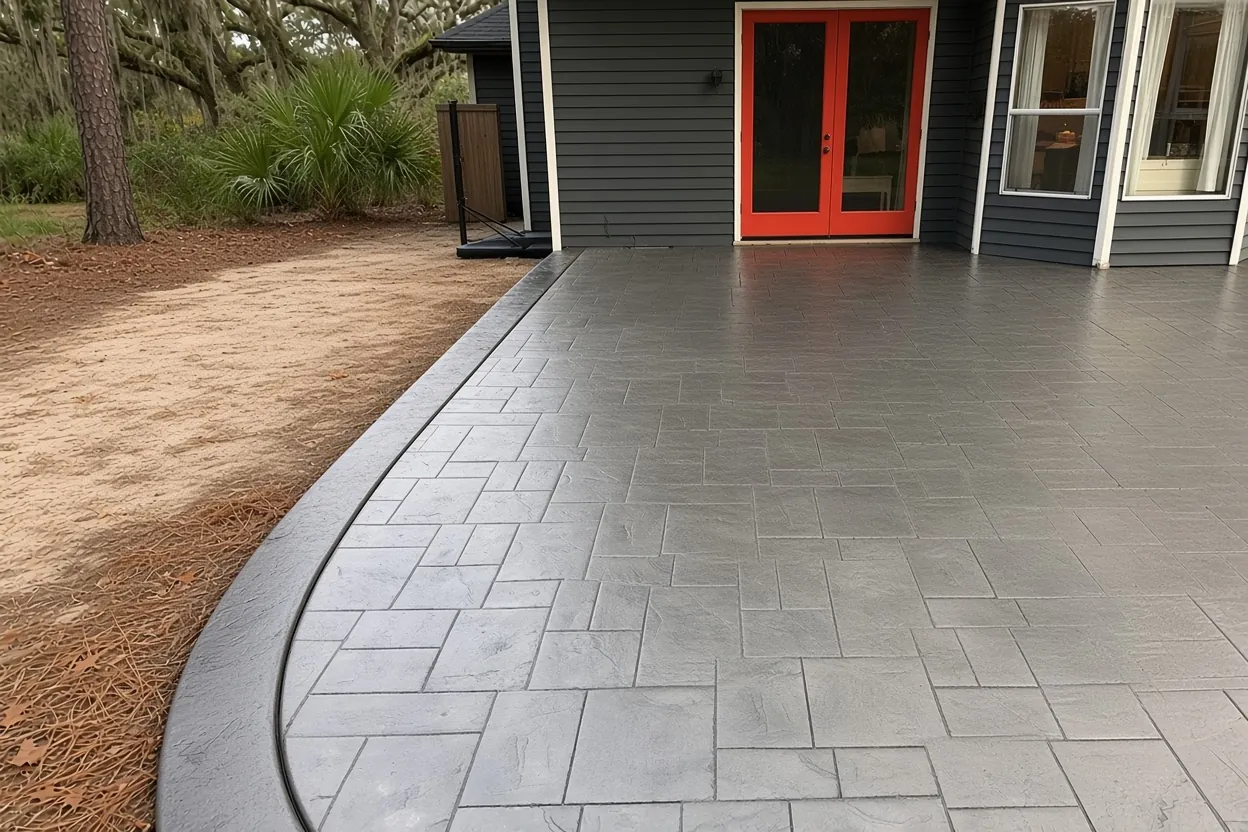
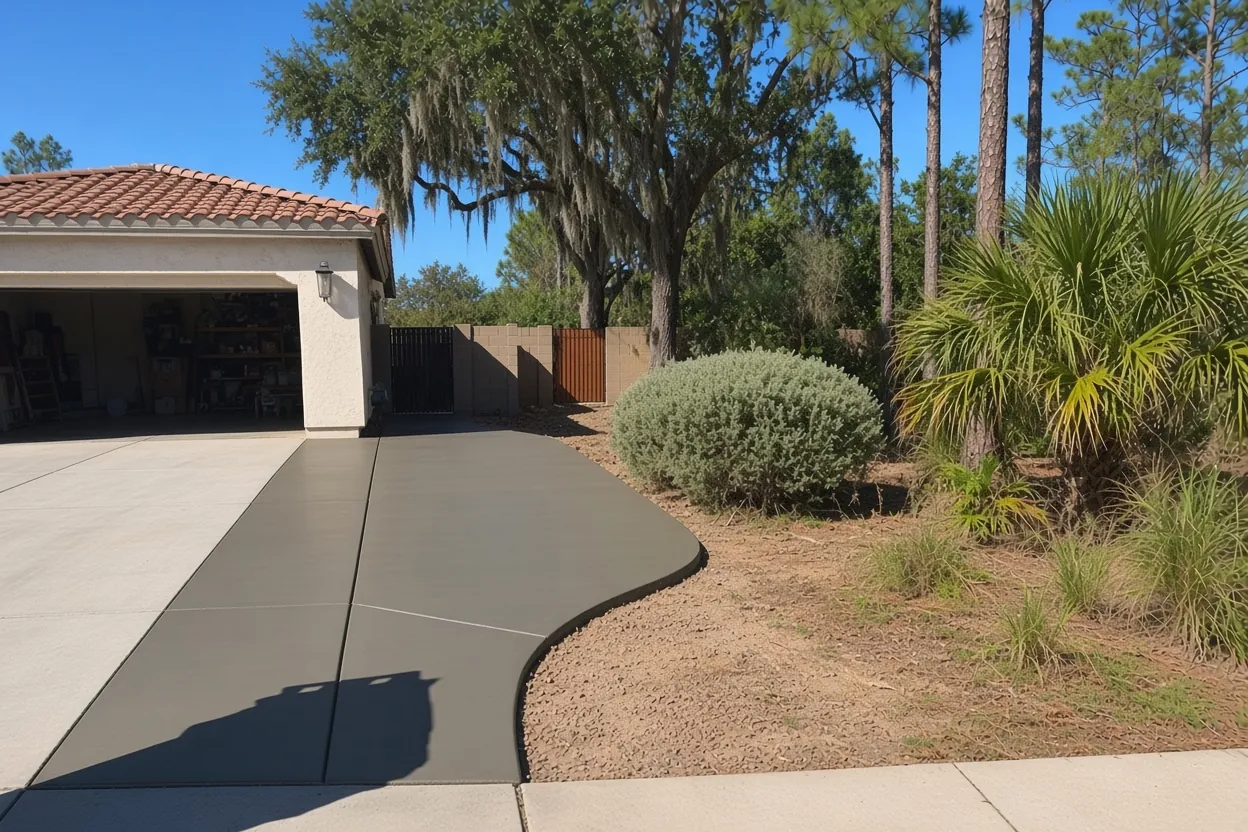
- Driveway borders. A stamped band along the edges with a broom-finish center keeps cost down on a long driveway. Inside city limits the right-of-way apron has its own spec, 6 inches of 3000 psi fiber concrete with wood crack-control joints and no steel, so we end the decorative field at the right-of-way joint unless Engineering approves something else for the apron.
- Pool decks. We stamp and color pool decks too. Plan it as a wet area with additive in the sealer from the start.
A pad for a shed or workshop is a structural job, and our slabs and foundations page covers that side. Stamped work is for the surfaces you want to look at.
Pricing a stamped job and what to bring to the visit
Our stamped range is $14 to $24 per square foot, covering the pattern, integral or release color and sealer. Typical projects run $5,000 to $16,000. Here's the square-foot math on a common size: a 16 by 20 foot back patio is 320 square feet, about $4,480 at $14 a foot and $7,680 at $24 a foot before any extras. Your own number comes after we see the yard.
- Layout. Curves, steps and borders add forming and stamping time.
- Color layers. One base with one release tone costs less than a field with several hand-applied accents.
- Tear-out. Removing an old slab adds $2 to $4 per square foot.
- Border and field. A broom-finish center inside a stamped border is priced at our plain rate of $8 to $14 per square foot for the plain part.
- Traction and sealer. Additive and sealer type are listed on the estimate.
When the contract on a permitted job tops $2,500, Florida requires a Notice of Commencement recorded with the Hillsborough County Clerk of Court, and over $5,000 a copy goes to the building department before the first inspection, so plan on that form. For the free on-site estimate, have a rough sketch with measurements, a photo of the house and roof, where water runs when it rains and any HOA or historic paperwork you already have. Call (813) 722-1744 or use the contact page. If a full driveway is on the table, the driveway cost breakdown shows how those lines stack.
Frequently Asked Questions
Is stamped concrete slippery when wet?
Stamped concrete or pavers in Florida?
How often does stamped concrete need resealing?
Why does stamped work cost more per foot than a broom finish?
Can the stamped pattern continue onto my driveway apron?
Can I put a stamped walk in front of a historic Plant City house?
When can we walk on a new stamped patio or park on a stamped border?
Sources
- Stamped Concrete Basics, Concrete Network
- Plant City Historic District Design Standards, City of Plant City
- Plant City FAQ, City of Plant City
- Concrete Driveway Installation: 8 Essentials, Concrete Network
- Hot Weather Concreting (CIP 12), NRMCA
- Plastic Shrinkage Cracking (CIP 5), NRMCA
- Stamped Concrete Driveway Cost: 2026 SWFL Price Per Sq Ft, CHC Concrete
- Walden Lake Neighborhoods, Walden Lake Community Association
- Walden Lake Community Association, Walden Lake Community Association
- Live Oaks, UF/IFAS Gardening Solutions
- Florida Thunderstorm Season / Rainy Season, NOAA National Weather Service Tampa Bay
- SR 60 PD&E Study Geotechnical Memorandum (April 2015), Florida Department of Transportation District Seven
Request Your Free Estimate
Tell us a little about the job. We'll call to set a time to come measure.
Thank you, we have it.
We'll call shortly to set a time to measure. Prefer to talk now? Call (813) 722-1744.
Other Concrete Services
Concrete Driveways
New driveways, extensions, and full tear-out replacements poured thick enough for Florida trucks and built to drain.
Learn MoreConcrete Patios
Backyard patios, lanai extensions, and screen-room slabs sized for real outdoor living in the Florida heat.
Learn MoreConcrete Sidewalks & Walkways
Front walks, side-yard paths, and city-spec sidewalks with proper joints so they don't crack and heave.
Learn MoreConcrete Slabs & Foundations
Slabs for sheds, workshops, garages, barns, and additions. Formed square, compacted right, ready to build on.
Learn MoreOur Service Areas
Concrete work across Plant City and its neighborhoods.
Page updated