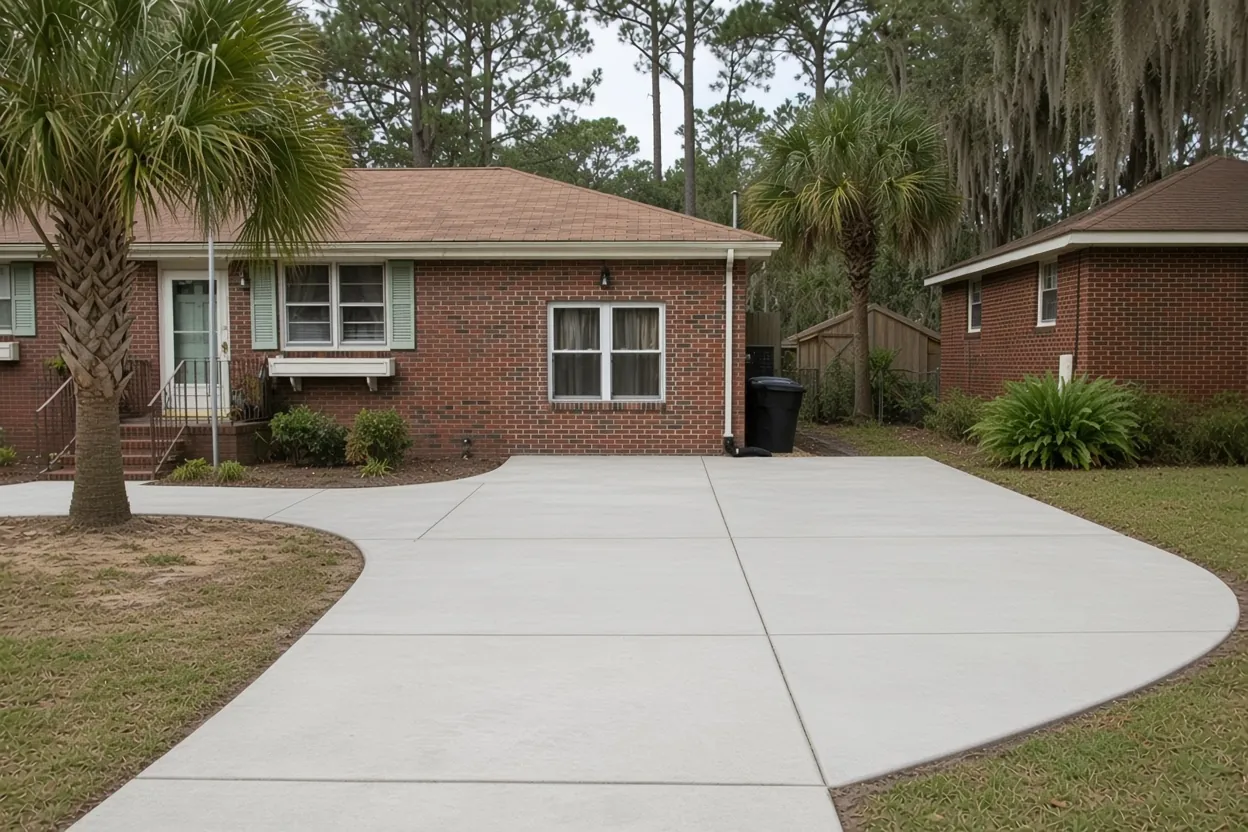
Driveways · Plant City, FL
Concrete Driveways in Magnolia Green, Plant City
Concrete driveway replacement and widening in Magnolia Green, Plant City. The city apron spec is built into your quote.
Straight Answers,
Written Quotes
Quick answer
Plant City Concrete Co replaces and widens concrete driveways in front of Magnolia Green homes in Plant City, and each job pours two specs: 4 to 5 inches on your lot, and a 6-inch, 3000 psi fiber apron with no steel inside the city right-of-way. A typical two-car driveway job runs $5,000 to $10,000 and gets written up after a free visit.
Slab age on a 2006 to 2017 street, and what it tells us at the curb
Every house in Magnolia Green went up between 2006 and 2017, on two plats recorded in June 2006 (Phase 1, 169 lots) and August 2007 (Phase 2, 144 lots). The Phase 2 homes date from 2014 to 2017, so their slabs are roughly ten years old. Phase 1 homes cover the whole window, and the oldest are nearing twenty. That's why two neighbors on Crystal Dew Street or San Moise Place, a few turns in from West Trapnell Road, can need very different jobs. Like the rest of Plant City, the neighborhood is in Hillsborough County, under a mile from Turkey Creek Road and Griffin Boulevard.
At the visit we look for sunken panels, edges that have dropped below the lawn, cracks that have opened and shifted, and an apron that tips water back at the garage. Some of that calls for a full concrete driveway replacement. Some needs only a new concrete driveway apron or a single panel. Our Magnolia Green neighborhood page covers patios, walks and pads here. This one sticks to the driveway.
Fort Meade, Ona and St. Johns sand under a parked pickup
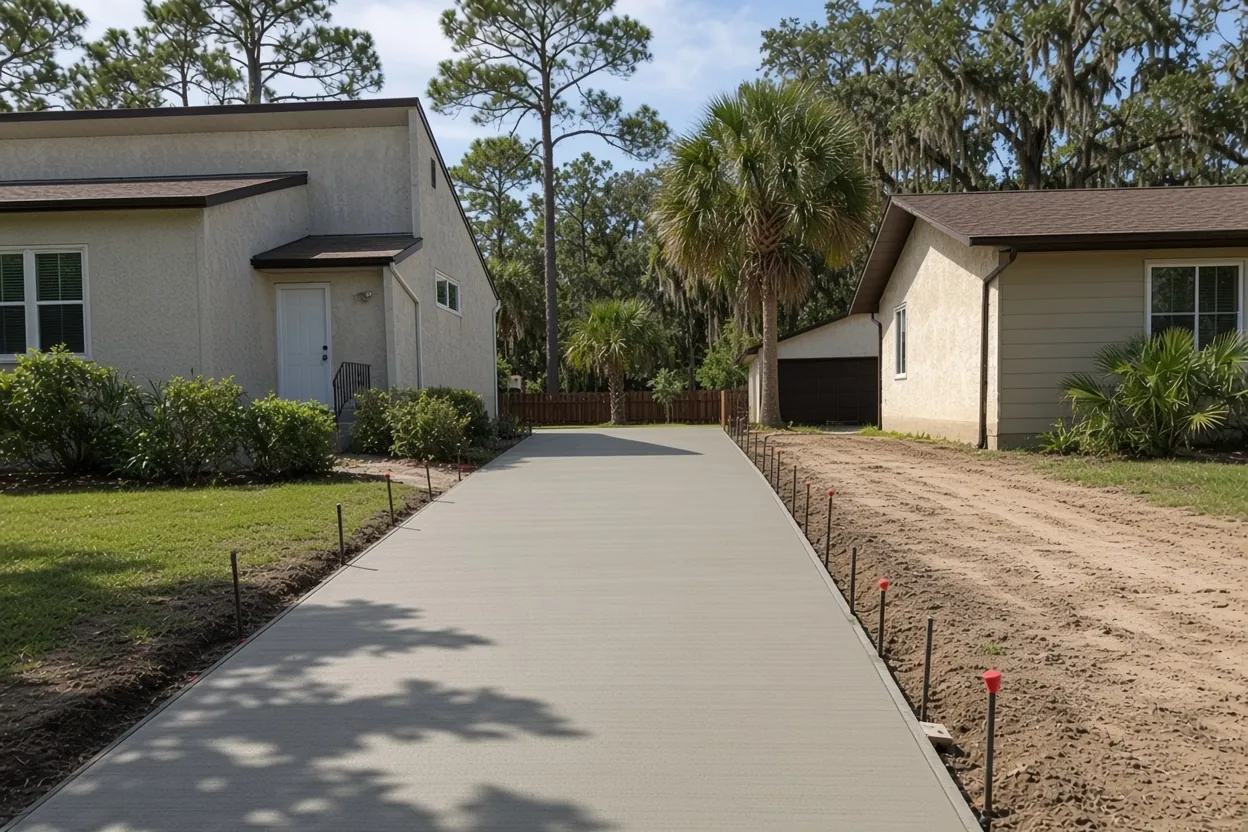
The county's USDA soil layer splits the Magnolia Green plats into a few sands. Roughly 23% is Fort Meade loamy fine sand, which drains well and is rated "not limited" for homes and local roads. About 41% is Ona fine sand and about 10% is St. Johns fine sand. Both are poorly drained, and St. Johns can hold its water table within about 6 inches of the surface. Those shares cover the whole platted area, not your yard, so we can probe your lot at the visit.
Here's why that matters for a driveway. Four inches is the residential minimum for a car driveway. Where a work truck or trailer parks every night, we can quote 5 inches, and on the wetter Ona and St. Johns sand, a well compacted base counts as much as the extra inch. Concrete Network puts the jump from 4 to 5 inches at about 20% more concrete cost for nearly 50% more load capacity. It also suggests thickening the edges 1 to 2 inches where tires ride close to them. FDOT's geotechnical memo for the SR 60 corridor through Plant City reports seasonal high groundwater within about 1 to 1.5 feet of the surface in fourteen mapped soil units along that corridor. That's a good reason not to pour onto a base that's still pumping water after a storm. Our sandy soil guide covers base prep in more detail.
Concrete Pricing
These are our driveway ranges for Magnolia Green. Your actual number comes in a free written estimate after we see the site.
| Driveway job | Per sq ft | Typical project | What moves the price |
|---|---|---|---|
| New two-car driveway, 4 to 5 in., broom finish | $8 to $14 | $5,000 to $10,000 | Footprint, 5 in. vs 4 in., apron length |
| Tear-out and replace | $8 to $14 plus $2 to $4 to remove | $5,000 to $10,000 plus removal | Old slab thickness, haul-off, apron rebuild |
| Side parking pad, 10 by 20 ft | $8 to $14 | $1,600 to $2,800 | Joint to the old slab, grading, meter box location |
Ranges, not a quote. The 6-inch city apron and a 5-inch slab both push toward the top of the range. You get a free written estimate after we see the site, sent within 48 hours.
Where your driveway meets the street: the apron rules Engineering enforces
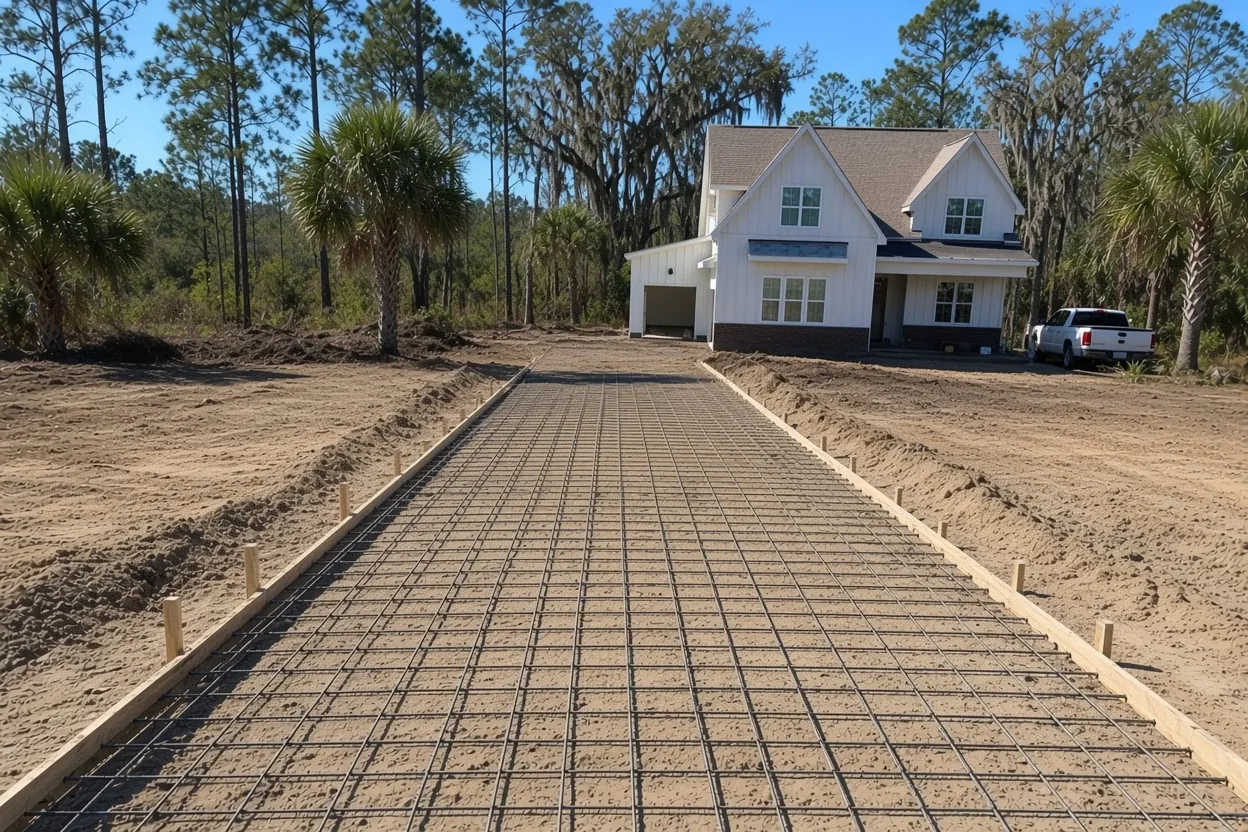
Nearly all of Magnolia Green, about 99.8% of the platted ground, sits inside Plant City limits. Where your driveway crosses public right-of-way at the street, the city's rules apply, and they're stricter than the spec on your side. Per the Plant City FAQ, any part of a driveway inside the right-of-way must be 3000 psi concrete with fiber, at least 6 inches thick, with no rebar or wire mesh.
The same page sets the details. Crack-control joints in the apron are full-depth pressure-treated wood, not saw cuts. They go at the edge of the right-of-way, along the roadway and along any sidewalk. The slope has to fall toward the road, and the city won't allow an inverted driveway that sends runoff at the house. Where a culvert is required, it's 15-inch concrete pipe at minimum, with mitered end sections. No sewer laterals, cleanouts, water service lines or meter boxes can sit in or under the driveway, so a widening that would cover your meter needs a plan before the forms go in.
The city inspects the apron forms before the pour, booked with 24 hours' notice. Once it's in, the apron is yours, since city repairs stop at the edge of pavement. Our Plant City driveway permit guide lays out the steps in order.
What to Expect, Start to Finish
Tell us the lot
Send your Magnolia Green street address and what's wrong with the driveway. We check the flood zone before we come out.
Walk the slab
We measure, probe the subgrade, note the meter box and cleanouts, and watch where water runs off the apron.
Quote and permit
You get your written quote within 48 hours. Once you approve it, the city permit and the apron form inspection go on the calendar.
Pour and protect
We pour, start curing right away, keep the street and lawn clean, and ask you to keep cars off for a week.
Unnumbered Zone A, HB 803 and the paperwork on a Magnolia Green driveway
Plant City lists driveways among the work that needs a permit, issued before anything starts, and wants the driveway drawn on a site plan. A new Florida law, HB 803, says local governments must exempt some single-family work under $7,500 from permits. For a driveway it's a narrow door, for three reasons. You need a written request and written approval first. Structural work is left out. And it doesn't apply to a property in a flood hazard area.
That last one bites in Magnolia Green. On FEMA panel 12057C0410H, about 24% of the platted area is mapped Zone A, a flood hazard zone with no published base flood elevation. North Park Isle and Madison Park, by contrast, have Zone AE areas with published base flood elevations. You can look up your own lot in FEMA's flood hazard layer, and we check it too before quoting. If any part of the property is in Zone A, plan on the full permit.
Then comes the lien paperwork. Under Florida Statutes 713.13 and 713.02(5), the owner or the owner's agent records a Notice of Commencement with the County Clerk before work starts on a job over $2,500. When the contract tops $5,000, a copy also goes to the building department before the first inspection, and our two-car range starts at $5,000.
Adding a parking pad beside the slab you already have
With median lots near 6,600 sq ft and homes around 2,200 sq ft of living space, Magnolia Green driveways have a little room to grow sideways, not a lot. One option is a driveway extension for a third car or a small trailer. A 10 by 20 foot pad is 200 sq ft, so at our $8 to $14 per sq ft it lands at $1,600 to $2,800 before any apron work.
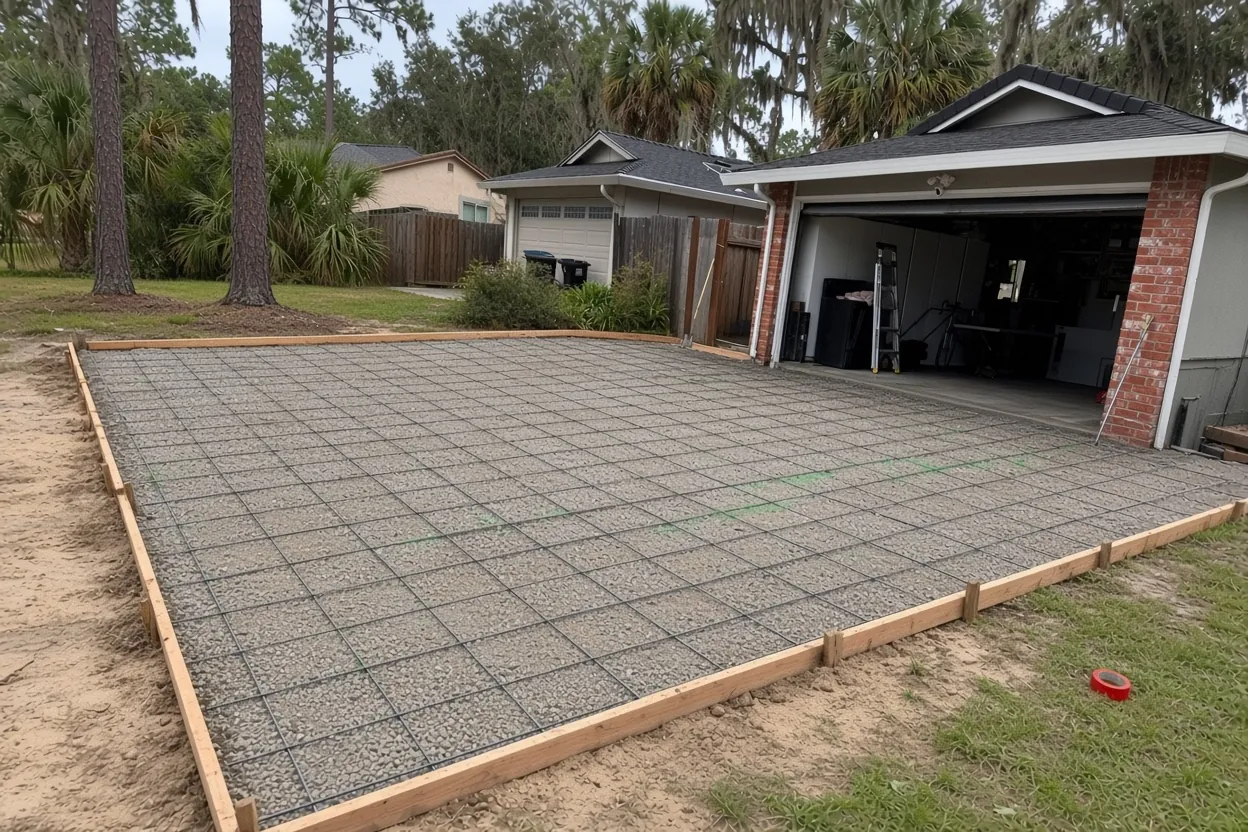
Wherever new concrete meets the old slab, the garage floor or a sidewalk, we set an isolation joint so each piece can move on its own. Control joints go no more than 10 feet apart and a quarter of the slab depth. For steel, trade guidance calls for wire mesh in a 4 to 5 inch slab and rebar on about a 12-inch grid at 5 inches and up. Fiber helps too, within limits. NRMCA says synthetic fibers cut early shrinkage cracking but must not stand in for thickness, wider joint spacing or structural steel. The apron itself still gets fiber and no steel.
More concrete also means more water coming off the lot. If the widening needs fill or changes where rain goes, Plant City's Streets and Stormwater staff may need to approve it, and we flag that on the quote. Thinking about a back slab too? The Magnolia Green patio page covers the yard side.
Pour dates from late May to mid October, and a week off the new slab
The National Weather Service sets West Central Florida's rainy season at May 25 to October 10, with the heaviest rain from July into early September. We can pour a Magnolia Green concrete driveway in those months, but the forecast moves the date around.
Curing starts the moment finishing ends. NRMCA calls for 3 to 7 days of moist curing under plastic sheeting at least 4 mils thick, wet burlap, or a membrane curing compound, and notes that white pigmented compounds reflect heat. Concrete that dries out early can lose up to half of its potential strength. Its hot-weather rules also say not to add water on site beyond the mix design, and not to sprinkle water on the surface to help finishing.
Keep cars off a new concrete driveway for at least a week. Want a fuller look at what each choice costs? See the Plant City driveway cost guide, or compare with our Walden Lake driveway page.
Frequently Asked Questions
How thick should a concrete driveway be on Magnolia Green's sandy lots?
Do I need a city permit to replace my Magnolia Green driveway?
How soon can I park on a new driveway in Magnolia Green?
Should a widened Magnolia Green driveway get rebar, mesh or fiber?
My water meter sits where I want the wider driveway. What happens?
Will the city fix my Magnolia Green apron if it cracks later?
Sources
- Plant City FAQ (driveway requirements, permits, apron upkeep), City of Plant City
- Soils_NRCS (SSURGO, Hillsborough County), USDA-NRCS via Hillsborough County GIS
- National Flood Hazard Layer: Flood Hazard Zones, FEMA
- HillsboroughCountySubDivisions (Magnolia Green plats), Hillsborough County GIS
- Concrete Driveway Installation: 8 Essentials, Concrete Network
- CIP 24: Synthetic Fibers for Concrete, National Ready Mixed Concrete Association
- Florida Statutes 713.13: Notice of commencement, Florida Legislature (Online Sunshine)
- Florida Thunderstorm Season / Rainy Season, NOAA National Weather Service Tampa Bay
- Florida Statutes 713.02: Types of lienors and amounts of liens, Florida Legislature (Online Sunshine)
- CIP 11: Curing In-Place Concrete, National Ready Mixed Concrete Association
Request Your Free Estimate
Tell us a little about the job. We'll call to set a time to come measure.
Thank you, we have it.
We'll call shortly to set a time to measure. Prefer to talk now? Call (813) 722-1744.
Other Concrete Services
Concrete Driveways
New driveways, extensions, and full tear-out replacements poured thick enough for Florida trucks and built to drain.
Learn MoreConcrete Patios
Backyard patios, lanai extensions, and screen-room slabs sized for real outdoor living in the Florida heat.
Learn MoreConcrete Sidewalks & Walkways
Front walks, side-yard paths, and city-spec sidewalks with proper joints so they don't crack and heave.
Learn MoreStamped & Decorative Concrete
Stamped and colored concrete for patios, driveways, and entries. The look of stone or pavers in one solid pour.
Learn MoreConcrete Slabs & Foundations
Slabs for sheds, workshops, garages, barns, and additions. Formed square, compacted right, ready to build on.
Learn MoreOur Service Areas
Concrete work across Plant City and its neighborhoods.
Page updated