Driveways · Plant City, FL
Concrete Driveways in Country Hills, Plant City
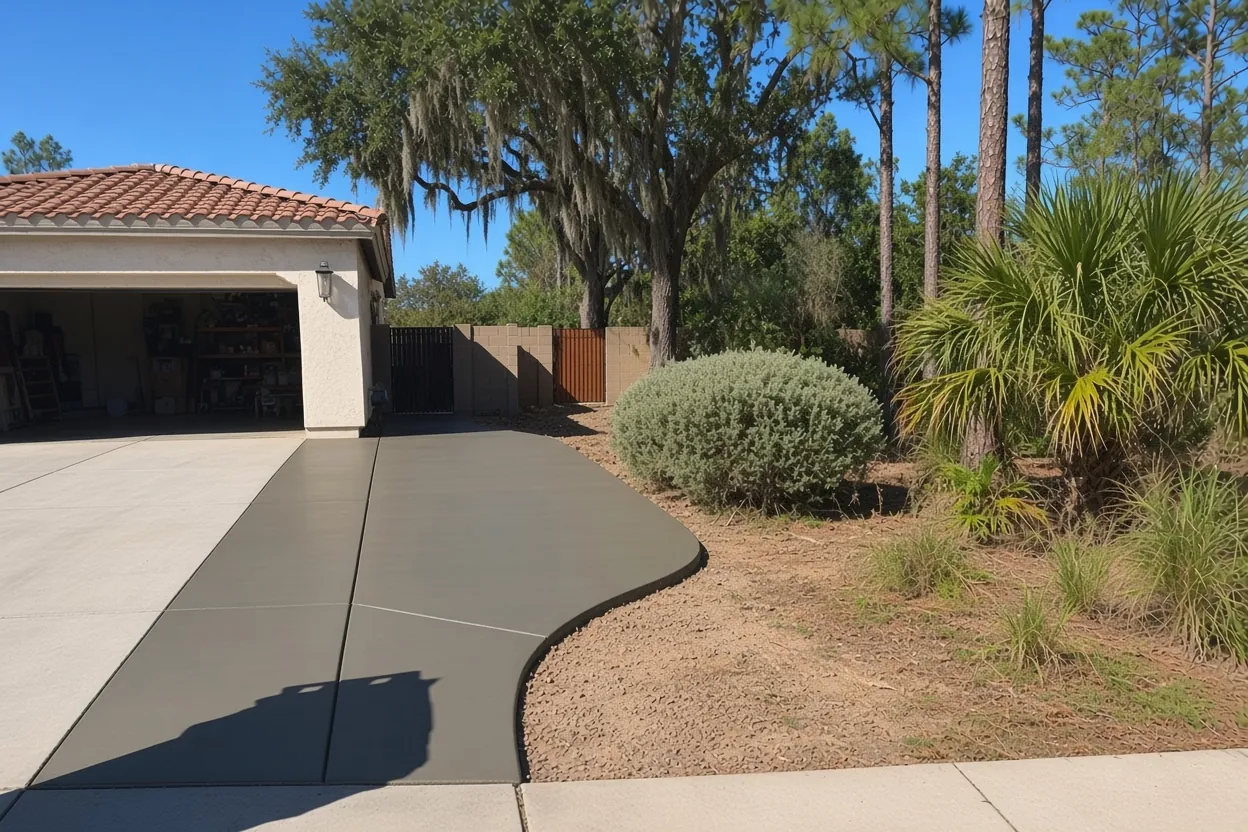
We replace and widen concrete driveways on Country Hills homes in Plant City, city apron included.
Straight Answers,
Written Quotes
Quick answer
Plant City Concrete Co replaces and widens concrete driveway slabs across Country Hills in Plant City, on lots platted between 1985 and 2002. The median house here dates to 1999, which puts plenty of original driveways past 25 years old. Our range is $8 to $14 per sq ft, plus $2 to $4 per sq ft to break out the old slab.
Dating the slab you have now: build years from 1985 to 2023
The 2026 Hillsborough County tax roll lists a year built for 698 parcels in Country Hills. The oldest is 1985, the newest 2023, and the median is 1999. Unless a past owner already paid to replace it, your concrete driveway is likely as old as the house. Every Country Hills plat, from the 1985 Unit One plats to the last Country Hills East units recorded in 2002, sits inside Plant City limits, so the City of Plant City issues the permit for every driveway here.
Age shows up as sunken corners, cracks that keep getting wider, or a gap opening at the garage floor. When a slab is past patching, we price it as a tear-out and repour. Our concrete driveway service page covers the full build. The Plant City driveway cost guide explains each line of a quote, and the Country Hills neighborhood page has the wider picture.
Base work on soil the survey rates very limited for streets
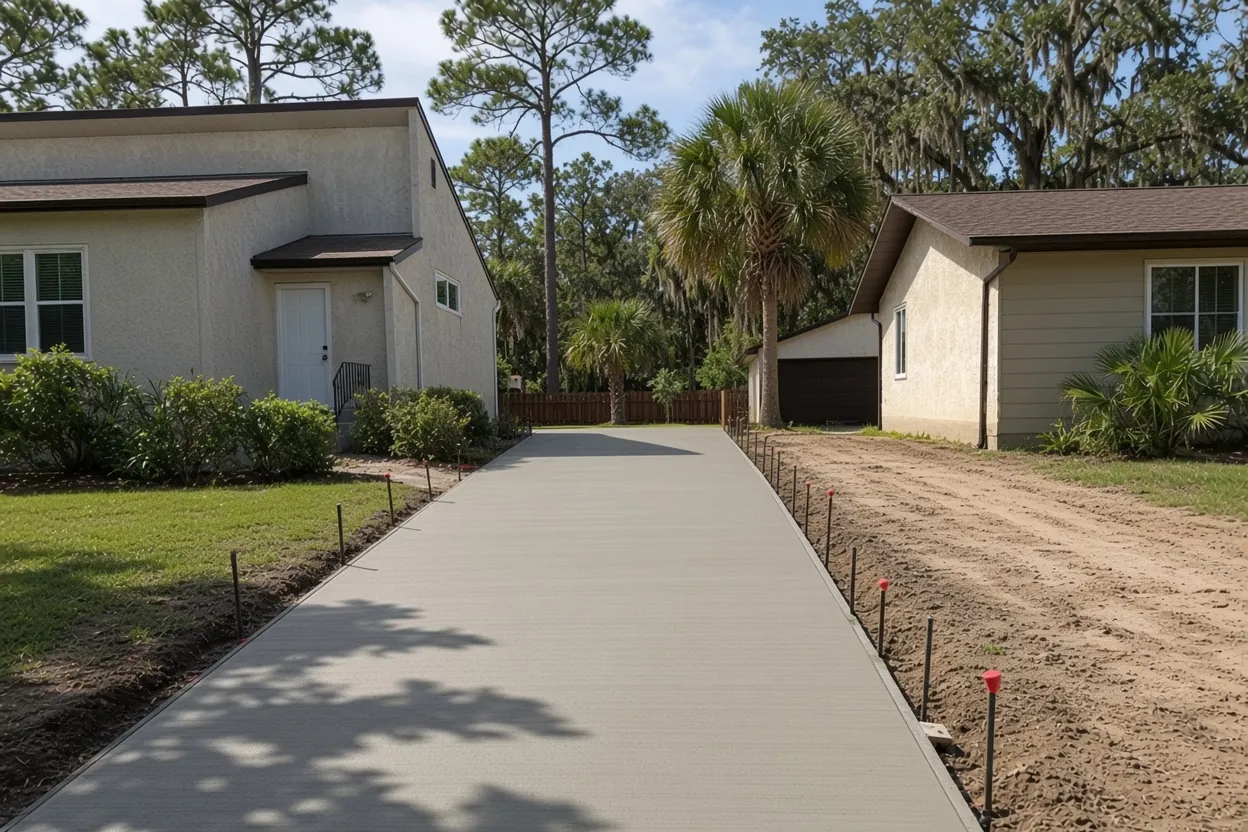
A driveway carries wheels, so read the soil survey's road rating first. Roughly 45 percent of the Country Hills plats map as Basinger, Holopaw and Samsula soils in depressions, and the USDA rates that unit very limited for local roads and streets as well as for houses. That unit falls in hydrologic group A/D, with groundwater right at the surface. Spartman Branch, a stream on the USGS map, runs through that same ground. The drier pockets are mostly sand: Fort Meade loamy fine sand, rated not limited, plus Archbold, Candler, Tavares-Millhopper and Seffner fine sand.
So what changes on a driveway? FDOT's geotechnical memo for the State Road 60 corridor through the Plant City area found the local terrace sands fit to carry a road once the subgrade is prepared and unsuitable organic soil comes out. The same logic holds at driveway scale. We can dig out anything dark and spongy and bring in clean fill. After compacting it, we set the grade so water heads for the street. On the low lots, price a 5-inch slab next to the usual 4. Concrete Network puts that extra inch at about 20 percent more concrete for nearly 50 percent more load capacity, and suggests thickened edges an inch or two deeper along the sides. Want more on compaction? Our guide to concrete on sandy soil goes further.
Concrete Pricing
Here's what driveway work in Country Hills runs at our rates. You get a free written estimate once we've walked the lot.
| Job | Per sq ft | Typical project | What moves the price |
|---|---|---|---|
| Replace a 2-car driveway (about 500 to 700 sq ft, 4 to 5 in.) | $8 to $14 plus $2 to $4 tear-out | $5,000 to $10,000 before tear-out | Old slab removal, fill on depressional soil, 5 in. upgrade |
| Side widening, 10 by 20 ft | $8 to $14 | $1,600 to $2,800 | Saw cut and isolation joint, meter box spot, drainage |
| Third-car or boat pad, 12 by 20 ft | $8 to $14 | $1,920 to $3,360 | Thickness for the load, fill on low ground |
| City apron rebuild only | Quoted after the visit | Quoted after the visit | 6 in. fiber spec, wood joints, form inspection |
Ranges, not a quote. Thicker concrete, extra fill and permit fees all move the total. We give you the free written estimate after seeing the site, and the written quote follows within 48 hours.
Mesh on your side of the line, fiber only in the city's strip
A Country Hills driveway is really two pours that meet at the right-of-way line. On your lot, the slab follows good trade practice. Between that line and the street, a written city rule takes over, and the two halves don't use the same reinforcement.
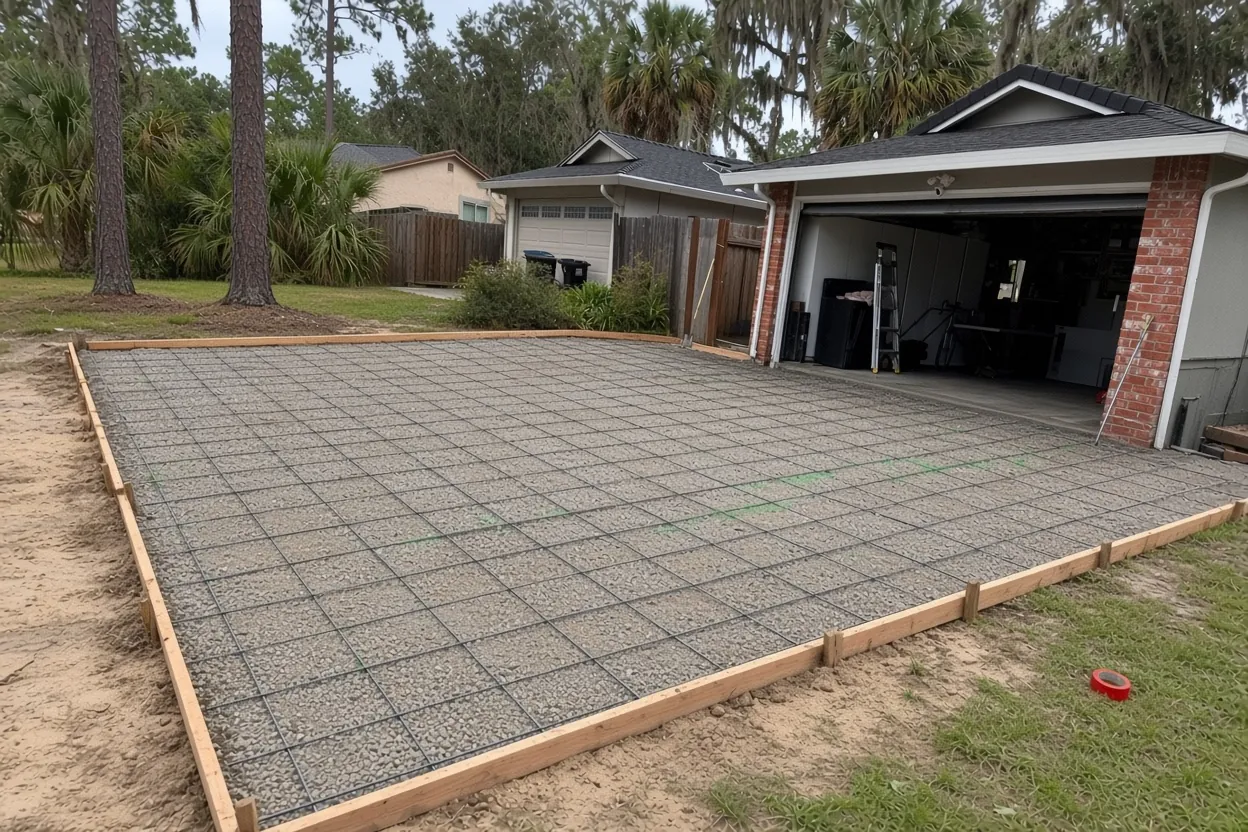
- House side: 4 inches minimum, 5 on soft ground or where a pickup, boat or RV parks. Wire mesh suits a 4 to 5 inch slab and rebar on roughly a 12-inch grid suits 5 inches and up. Control joints sit no more than 10 feet apart, cut a quarter of the slab depth, with isolation joints at the garage floor and the sidewalk.
- City strip: a fiber-reinforced 3000 psi mix, 6 inches minimum, with zero steel. Joints there are full-depth pressure-treated wood, never saw cuts, and the whole driveway has to slope toward the road.
- Utilities: no meter box, cleanout or service line may sit under the driveway, so a widening that would cover one needs a new layout.
Fiber holds down early shrinkage cracks. NRMCA is plain that it doesn't replace steel or justify a thinner slab, so on the house side it's an add-on, not a swap. Before any concrete arrives, the city inspects the apron forms, and it needs 24 hours' notice to book that visit. You'll find the apron spec and permit steps in full on the Plant City help center and in our driveway permit guide.
What to Expect, Start to Finish
Send the address
Whether you're on Ethan Way, Copper Lane or Westwind Drive, with your address we can pull the parcel record and check the flood map before we show up.
Free visit at the lot
We measure, find the meter box and cleanouts, and look at where water sits. We also plan how the concrete truck reaches your street off Country Hills Boulevard.
Written quote in 48 hours
Tear-out, base work, the house-side slab and the city apron show as separate lines, with the permit steps listed.
Permit, form check, pour
First the city permit, then the apron form inspection on 24 hours' notice, then the pour. We clean the street and yard before leaving.
Room for a third car on a lot of about 6,000 square feet
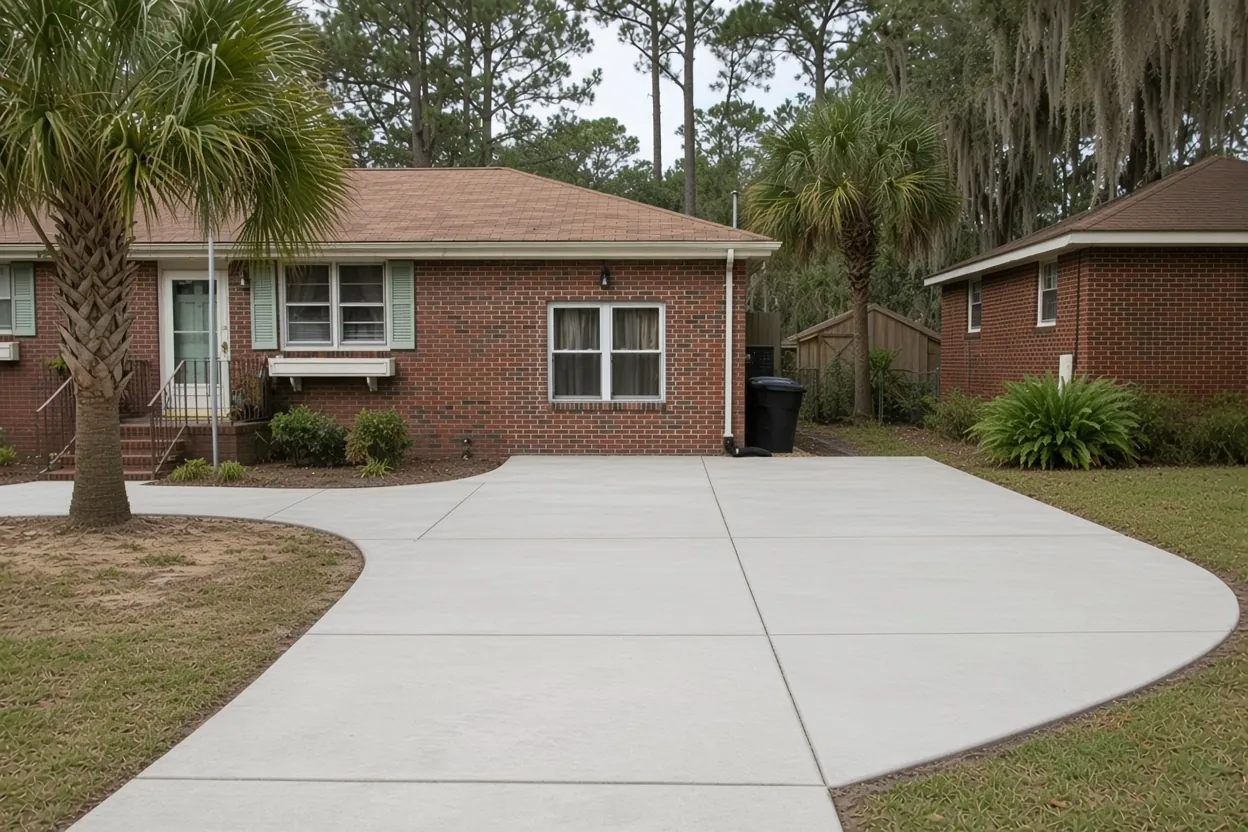
The median single-family lot in Country Hills is about 6,000 sq ft, and the median house has roughly 1,567 sq ft of living space. That can leave only a narrow strip beside the driveway. Want it paved for a boat, a third car or a trailer? A driveway extension is a smaller job than a full replacement. We can saw a straight edge on the old slab and set an isolation joint where new meets old, then match the broom texture. The color is another story: fresh concrete won't match the old slab on day one.
Three things set the limits before you pick a size. Plant City wants every driveway drawn on a site plan with its setbacks when the permit goes in. The utility rule above can sink a layout if the meter box sits in the strip you want to pave. Drainage counts too on the wetter soil here. Pave over a side yard and that rain has to go somewhere other than your neighbor's lot or your garage. Fill or a new drainage path may need approval from Streets and Stormwater at the city, and we can flag that on the quote when a plan needs it.
For scale, a 10 by 20 foot side strip is 200 sq ft, about $1,600 to $2,800 at our per-foot range before permit costs. Planning a back slab at the same time? See our page on concrete patios in Country Hills.
Pour dates between May storms and the October dry-out
The National Weather Service sets West Central Florida's rainy season at May 25 to October 10. July through early September brings the heaviest rain and the flooding concerns. That's when the depressional ground in Country Hills holds water longest. A soaked, puddled base has to drain before the forms get filled, so a summer date can slide.
Then there's the heat. NRMCA's hot-weather guidance says to skip the hottest part of the day when you can, dampen the base without leaving puddles, never add water at the truck beyond the mix design, and start curing as soon as finishing wraps up. Curing should run at least 3 days under wet burlap, plastic or a membrane compound, and a white pigmented compound reflects heat. Concrete that dries out too early can lose as much as half its potential strength.
Once it's poured, keep the car off for at least a week. A sealer can go on about 30 days later and again roughly every 2 years. Neighbors in Walden Lake, Lincoln Park and North Park Isle have their own driveway pages, since their ground differs.
Frequently Asked Questions
How thick should a concrete driveway be on the wet side of Country Hills?
Does a Country Hills driveway replacement need a city permit?
How long before I can park on a new driveway in Country Hills?
Which reinforcement belongs in a Country Hills driveway: rebar, mesh or fiber?
Can you widen my Country Hills driveway without tearing out the whole slab?
My Country Hills driveway puddles toward the garage. What fixes that?
Which months are easiest for pouring a driveway in Country Hills?
Sources
- Information Search FAQs (driveway, permit, drainage), City of Plant City
- Florida Statewide Cadastral, 2026 assessment roll, Florida Statewide Cadastral (ArcGIS Online)
- Soils_NRCS (USDA-NRCS SSURGO, FL057), Hillsborough County / USDA-NRCS
- National Flood Hazard Layer, flood hazard zones, FEMA
- Concrete Driveway Installation: 8 Essentials, Concrete Network
- CIP 12 - Hot Weather Concreting, National Ready Mixed Concrete Association
- CIP 24 - Synthetic Fibers for Concrete, National Ready Mixed Concrete Association
- SR 60 PD&E Study Geotechnical Memorandum (April 2015), Florida Department of Transportation District Seven
- Florida Statutes 713.02 (types of lienors; $2,500 exemption), The Florida Legislature (Online Sunshine)
Request Your Free Estimate
Tell us a little about the job. We'll call to set a time to come measure.
Thank you, we have it.
We'll call shortly to set a time to measure. Prefer to talk now? Call (813) 722-1744.
Other Concrete Services
Concrete Driveways
New driveways, extensions, and full tear-out replacements poured thick enough for Florida trucks and built to drain.
Learn MoreConcrete Patios
Backyard patios, lanai extensions, and screen-room slabs sized for real outdoor living in the Florida heat.
Learn MoreConcrete Sidewalks & Walkways
Front walks, side-yard paths, and city-spec sidewalks with proper joints so they don't crack and heave.
Learn MoreStamped & Decorative Concrete
Stamped and colored concrete for patios, driveways, and entries. The look of stone or pavers in one solid pour.
Learn MoreConcrete Slabs & Foundations
Slabs for sheds, workshops, garages, barns, and additions. Formed square, compacted right, ready to build on.
Learn MoreOur Service Areas
Concrete work across Plant City and its neighborhoods.
Page updated