Driveways · Plant City, FL
Concrete Driveways in Whispering Woods, Plant City
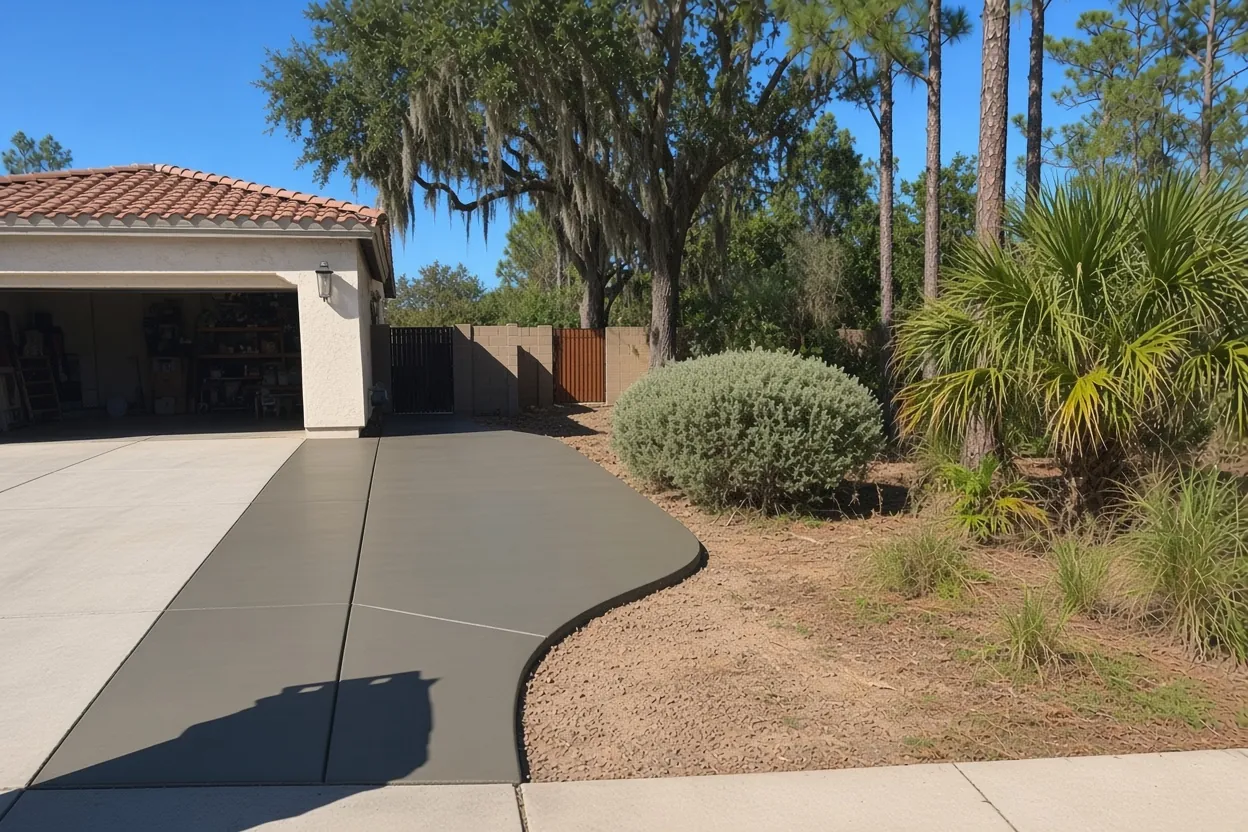
Concrete driveway replacement, widening and side pads for homes in Whispering Woods, Plant City.
Straight Answers,
Written Quotes
Quick answer
Plant City Concrete Co replaces and widens concrete driveway slabs in Whispering Woods, Plant City, where every home went up between 2009 and 2014. Your driveway sits on wet fine sand, and most streets here are coded private. That's why the free visit checks the base, the strip at the curb and your flood zone before we price anything.
A 2009 to 2014 slab and what replacing it involves
Whispering Woods has 141 single-family homes on two plats. In Phase 1 the median build year is 2009. Phases 2 and 3 are newer, with a median of 2013. Depending on the phase, that puts your driveway somewhere between about 12 and 17 years old. Age alone doesn't condemn a slab. The signs that matter more are settled panels, a lip at the garage, cracks that keep widening or water that sits on the concrete after rain.
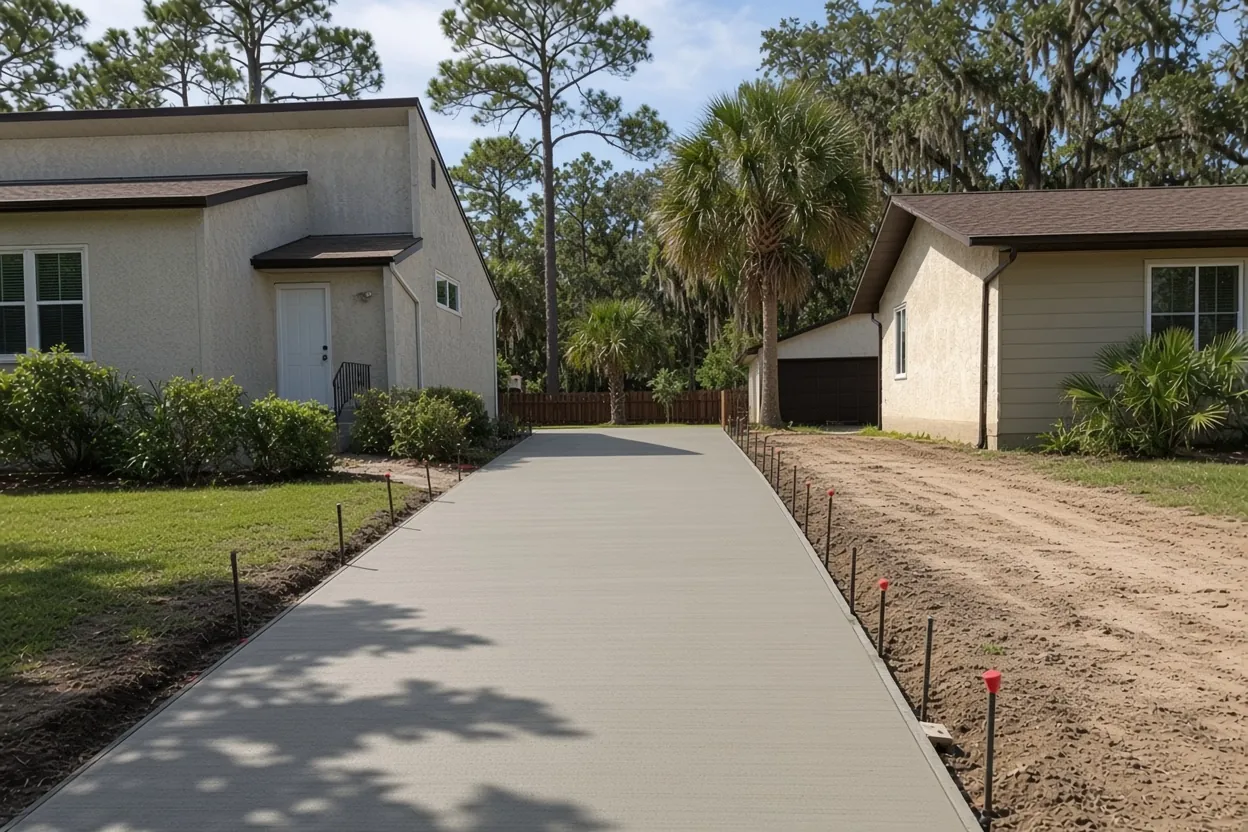
Driveway work here falls into three kinds: a full tear-out and new concrete driveway, an extension along the garage, or a separate side pad for a trailer or a third car. All three start with the same visit and end with a written quote within 48 hours. Our concrete driveways page explains how we build driveways across town. For patios, walks and the neighborhood as a whole, see the Whispering Woods neighborhood page.
Holly Bluff Court and Bronze Bush Court are coded private: sorting out the curb strip
On the 2026 tax roll, the addressed parcels in Whispering Woods sit on Holly Bluff Court (110), Walden Woods Drive (64), Bronze Bush Court (10) and Intrepid Way (1). Hillsborough County's road layer codes Holly Bluff Court, Bronze Bush Court and most of the Walden Woods Drive stretch along the plats as privately owned and privately maintained. A couple of short pieces, on Holly Bluff Court and Intrepid Way, show city ownership with private upkeep.
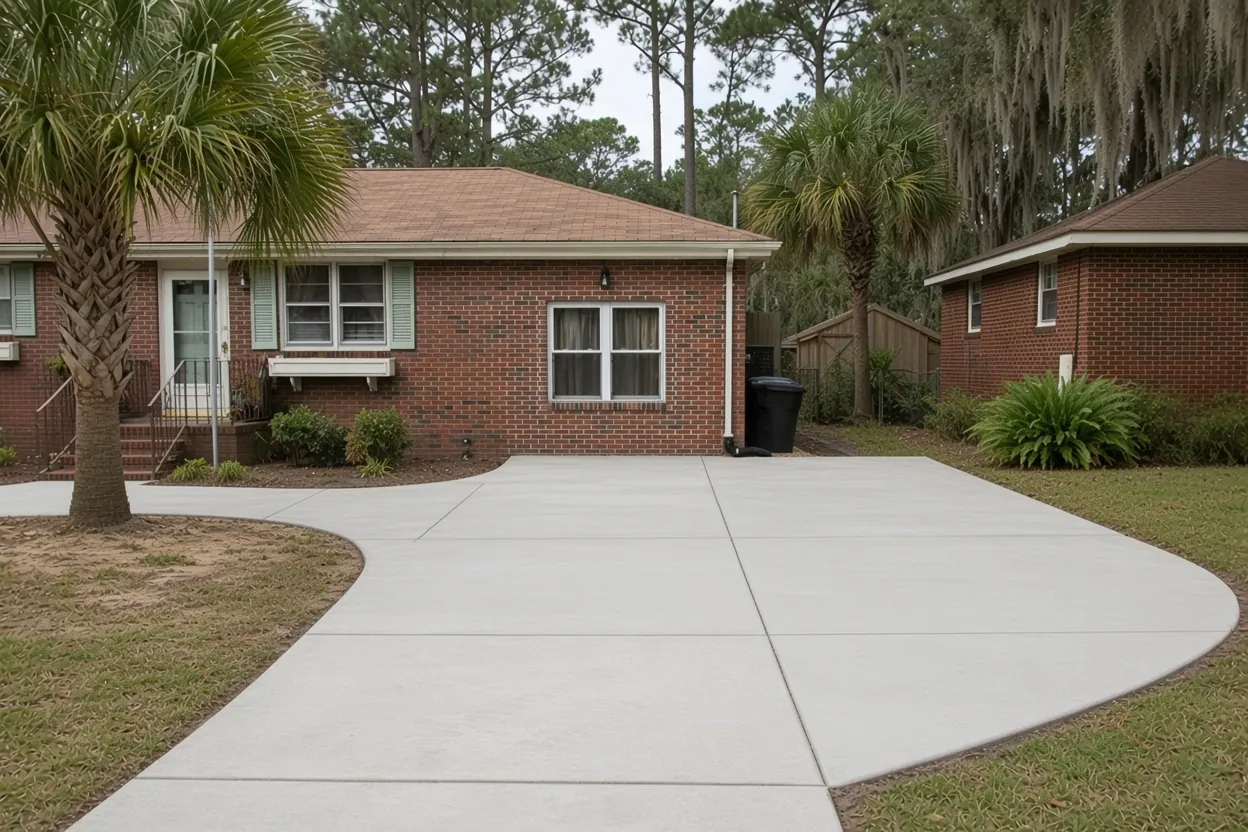
That coding matters for the apron, the strip between your lot and the pavement. The City of Plant City FAQ sets its apron rules for city right-of-way: 3000 psi concrete with fiber, at least 6 inches thick, no rebar or mesh, full-depth pressure-treated wood joints in place of saw cuts, and a 15-inch concrete culvert pipe where one is required. Nothing can sit under the driveway, whether it's a meter box, cleanout, lateral or water service line, and the slab has to slope toward the road. The City inspects the apron forms before the pour, on 24 hours' notice.
On a street coded private, the strip in front of your lot may not be city right-of-way at all. Before forms go in at the curb, ask the City's Engineering staff and your homeowners association which rules cover your frontage. Know this too: the City doesn't repair aprons, and its repairs stop at the edge of pavement. Our Plant City driveway permit guide walks through the paperwork.
Concrete Pricing
Driveways in Whispering Woods follow our standard ranges. What moves the total is base repair on wet sand, tear-out and the curb strip.
| Job | Per sq ft | Typical project | What moves the price |
|---|---|---|---|
| Full replacement, 4 to 5 in., broom finish (about 500 to 700 sq ft) | $8 to $14 | $5,000 to $10,000 | Thickness, base repair, thickened edges |
| Removing the old driveway | Adds $2 to $4 | Priced at the visit | Slab thickness, hauling |
| Extension along the garage or a side pad | $8 to $14 | Priced at the visit | Tie-in joint, utilities in the path |
| Apron at the curb | $8 to $14 | Priced at the visit | Which spec applies, fiber mix, wood joints |
Treat these as ranges, not quotes. Once we've seen the driveway, you get a free written estimate within 48 hours, with removal, base work and permit steps each on their own line.
Myakka and Malabar sand that the soil survey rates very limited for streets
Here's the ground under your new concrete driveway. Across the platted area, the county's soil layer maps about 46% Myakka fine sand, about 28% depressional Basinger, Holopaw and Samsula soils, and about 20% Malabar fine sand. Paisley fine sand in depressions and a little Seffner fine sand make up the rest. Those shares cover the whole subdivision, ponds and common land included. Read them as a picture of the area, not a test of your lot.
For a driveway, the water table is the number to watch. The survey puts it as shallow as about a foot in Myakka, about 6 inches in Malabar and right at the surface in the depressional soils. All four main units carry a "very limited" rating for local roads and streets, and a driveway is a small road. So base work counts for more here than on high, dry sand. Soft spots can be dug out, organic material removed and the subgrade compacted evenly, with clean sand added in lifts where the grade runs low.
Thickness comes next. Concrete Network lists 4 inches as the residential minimum. It says going to 5 inches adds roughly 20% to concrete cost while raising load capacity nearly 50%. It also suggests thickened edges, 1 to 2 inches deeper and reaching 4 to 8 inches in from the edge. Our usual range is 4 to 5 inches with a broom finish. If a pickup, boat or delivery truck uses the slab, get 5 inches and thickened edges priced.
What to Expect, Start to Finish
Free visit
We measure the slab, look over the curb strip and your survey, and check where rain stands.
Quote in 48 hours
Thickness, reinforcement, joints, base work and paperwork, all spelled out in writing.
Permit and form check
The City permit comes first. Where the apron rule applies, the forms get inspected on 24 hours' notice.
Pour and cure
We schedule the pour around the weather, start curing right after finishing and leave the site clean.
Wire mesh, rebar or fibers: reinforcing a 4 or 5 inch slab
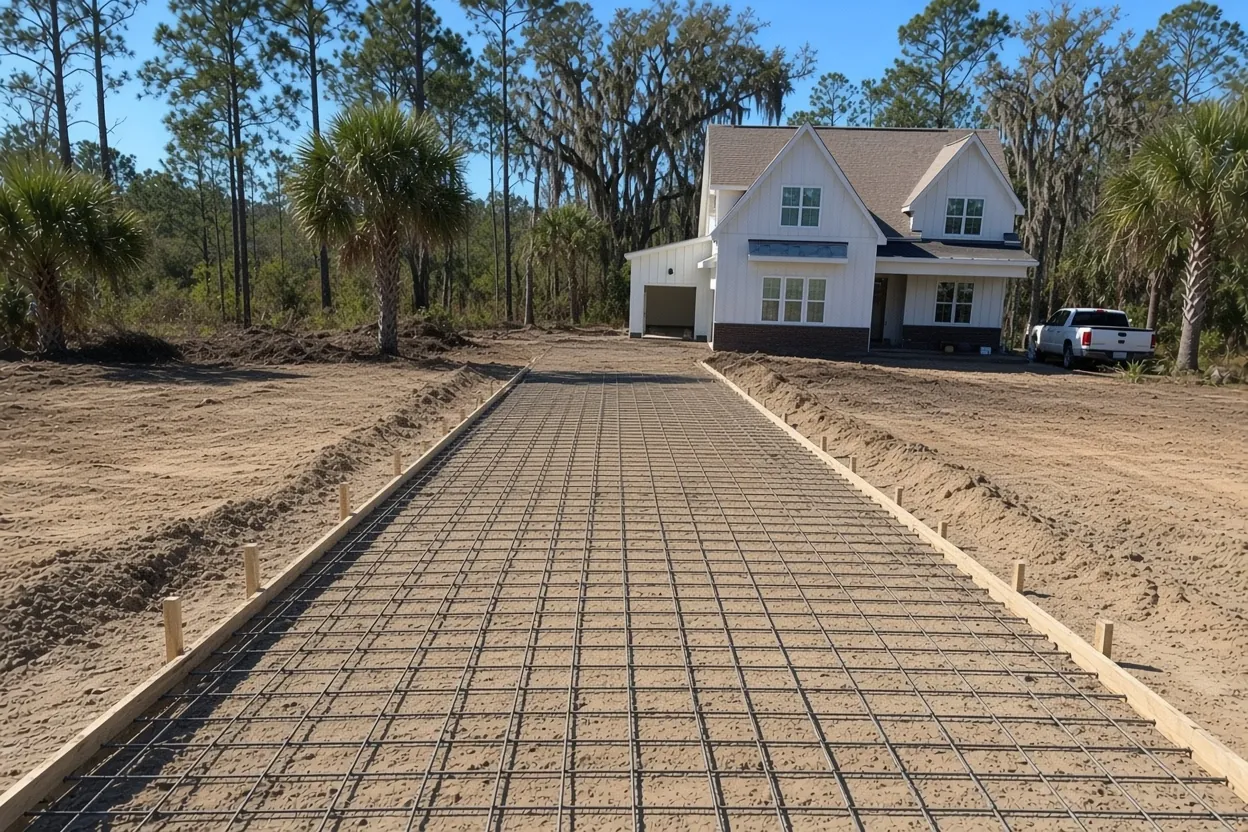
The right reinforcement depends on how thick the slab is. Concrete Network's guidance calls for wire mesh in 4 to 5 inch driveway slabs and rebar on roughly a 12-inch grid for slabs 5 inches and thicker.
Fibers do a different job. NRMCA's guide on synthetic fibers says that at typical doses of 1 to 2 pounds per cubic yard, they cut plastic shrinkage and settlement cracking and add toughness. The same guide says fibers must not be used to thin the slab, stretch the joint spacing or replace structural steel. Plant City's apron rule calls for fiber concrete with no steel. So a quote here can carry two specs: mesh or rebar on your side, and fiber only in the apron if the City's rule covers your frontage.
Joints handle the other half of crack control. On a 4-inch driveway, control joints go no more than 10 feet apart and a quarter of the slab deep, so about an inch. Isolation joints go where the driveway meets the garage floor, a walk or any old slab you keep. On an extension, the joint between old and new concrete is the line you'll see every day, so we can mark where it lands during the visit.
Zone AE frontage, the lien notice and a City permit for the driveway
Both Whispering Woods plats sit entirely inside Plant City limits, so the City of Plant City Building Department issues the permit. The City's FAQ lists driveways among the jobs that need one before work starts, and the driveway has to appear on a site plan. Keep your survey handy.
Next, the flood map. FEMA panel 12057C0430H puts about 57% of the platted area in the Special Flood Hazard Area, mostly Zone AE, with at least 15 different base flood elevations between 131.5 and 137.5 feet. The zones follow the ponds and depressions, and some homes sit on raised pads, so check your own parcel. If any part of the property is in a flood hazard area, Florida's HB 803 exemption for single-family work under $7,500 doesn't apply. Our typical full replacement runs $5,000 to $10,000. That can land on either side of the line, and a small side pad can come in under it. Where the exemption is available, it takes a written request and approval before work starts.
Florida's lien law adds a Notice of Commencement. It's recorded with the County Clerk before work starts on any improvement over $2,500. Over $5,000, a copy also goes to the building department before the first inspection. If the plan includes raising the grade or adding a drain, the City says that kind of change often needs its own approval from Streets and Stormwater.
Getting the mixer in past the Walmart, then a week off the slab
The plats are easy to find. The Walmart Supercenter is about 90 meters away, and the Plant City Police Department is about 400 meters off. East Alexander Street, East Sparkman Road and James L. Redman Parkway all run close by. On pour day the truck needs a clear path to the forms, so move cars off the street side of the driveway the night before.
Weather sets the schedule. The National Weather Service puts the Tampa Bay rainy season from May 25 to October 10, with July through early September as the heavy-rain stretch. A pour in those months means watching the afternoon storms. If one builds, we can cover the fresh concrete.
Then comes curing. NRMCA calls for curing to start right after finishing and run 3 to 7 days, and it warns that concrete left to dry out can lose as much as half its potential strength. Keep the car off it for at least a week. IRMCA's homeowner sheet puts sealer at about 30 days and again every 2 years. We leave the jobsite clean. Comparing neighborhoods? See our driveway pages for Walden Woods, Walden Lake, Magnolia Green, Lincoln Park, Country Hills and North Park Isle.
Frequently Asked Questions
What thickness suits a driveway over the wet sand in Whispering Woods?
Does replacing my Whispering Woods driveway need a City of Plant City permit?
After the pour, how many days until I can park in my Whispering Woods driveway?
Should my Whispering Woods driveway have rebar, wire mesh or fiber?
Who looks after the concrete strip by the street on Holly Bluff Court?
Can I add a parking pad beside my Whispering Woods driveway if my lot maps in Zone AE?
Sources
- Information Search FAQs (driveway requirements, permits, aprons), City of Plant City
- Building Department, City of Plant City
- AllRoads street centerlines, Hillsborough County GIS
- Soils (NRCS SSURGO), Hillsborough County GIS / USDA-NRCS
- National Flood Hazard Layer, Flood Hazard Zones, FEMA
- Concrete Driveway Installation: 8 Essentials, Concrete Network
- CIP 24: Synthetic Fibers for Concrete, NRMCA
- CIP 11: Curing In-Place Concrete, NRMCA
- Driveways (homeowner technical resource), Illinois Ready Mixed Concrete Association
- Florida Thunderstorm Season / Rainy Season, NOAA National Weather Service Tampa Bay
- Florida Statutes 713.13, Notice of commencement, The Florida Legislature (Online Sunshine)
Request Your Free Estimate
Tell us a little about the job. We'll call to set a time to come measure.
Thank you, we have it.
We'll call shortly to set a time to measure. Prefer to talk now? Call (813) 722-1744.
Other Concrete Services
Concrete Driveways
New driveways, extensions, and full tear-out replacements poured thick enough for Florida trucks and built to drain.
Learn MoreConcrete Patios
Backyard patios, lanai extensions, and screen-room slabs sized for real outdoor living in the Florida heat.
Learn MoreConcrete Sidewalks & Walkways
Front walks, side-yard paths, and city-spec sidewalks with proper joints so they don't crack and heave.
Learn MoreStamped & Decorative Concrete
Stamped and colored concrete for patios, driveways, and entries. The look of stone or pavers in one solid pour.
Learn MoreConcrete Slabs & Foundations
Slabs for sheds, workshops, garages, barns, and additions. Formed square, compacted right, ready to build on.
Learn MoreOur Service Areas
Concrete work across Plant City and its neighborhoods.
Page updated